Alternatives — specification or badge
A Dahua Alternative for Commercial Building CCTV Cameras and Recorders
A camera range is judged on what it does on your building at two in the morning, not on which shelf it came from. If you are comparing us with a brand you have specified before, the comparison that survives scrutiny is a line-by-line specification and price: cameras, PoE budget, cabling, recorder, storage and the client your team watches. We publish our own specifications and pricing; we do not publish claims about other manufacturers’ products that we cannot document.
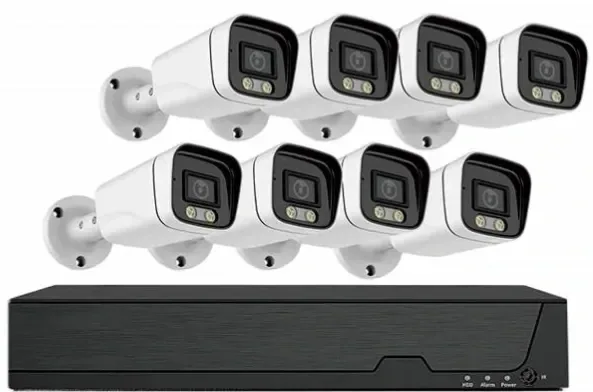
- Full colour night vision: colour to 0.1 Lux at F1.0
- PoE switching at 120 W / 250 W / 320 W, 250 m extend mode
- Recorders from 10 to 64 channels, 14 TB or 18 TB per bay
- Existing IP cameras keep working over ONVIF, RTSP and GB28181
You are replacing a chain, not a box
Every commercial CCTV system, whatever name is on the hardware, is the same five-link chain: camera, PoE switch, CAT6 run, recorder, display or client. A brand swap is a decision about each link separately, and the arithmetic only makes sense when it is done that way.
This is why we quote the whole building rather than a camera. A camera that needs more light than the position has, a switch whose wattage was never added up, a cable run past the 100 m limit, or a recorder whose bays cannot hold your retention period — any one of those turns an elegant camera comparison into a system that disappoints. The quote should show all five links, with the arithmetic visible.
The specification items that decide the outcome
| Item | Why it decides the outcome | What our range answers |
|---|---|---|
| Resolution and ladder | 5 MP costs more storage than 2 MP, and some channels do not need the top rung | 5 MP at 2880 × 1620, with 4 MP 2560 × 1440, 3 MP 2304 × 1296 and 2 MP 1920 × 1080 as alternatives |
| Night behaviour | The difference between colour and monochrome evidence, and between needing a floodlight or not | 1/2.7-inch low-light CMOS, F1.0, colour to 0.1 Lux, black and white to 0 Lux with the illuminator on |
| Compression and bitrate | Directly sets how many days of footage fit on the drives you buy | H.265+ / H.265 / H.264, main stream 500–8000 kbps, sub-stream 50–2000 kbps, 25 fps |
| PoE budget | Undersized switching is the most common reason a camera drops off the network at night | 120 W on the 8-port, 250 W on the 16-port, 320 W on the 24-port, with 250 m extend mode on the PS series |
| Recorder capacity | Channel count, access bandwidth and bays decide both the camera count and the retention | 10 to 64 channels, 64 Mbps access bandwidth, 1 to 8 bays, 14 TB or 18 TB per drive, 4K HDMI output |
| Users and clients | How many people can watch, and from what device, without sharing one login | Up to 38 local users on the recorder; Seetong Cloud clients on iOS, Android and Windows |
Fill this sheet in twice, once per quote. The rows you cannot fill in are the rows where the quote is silent — and silence is what a price difference usually hides in. One naming note while you are comparing: Seetong Cloud is the platform layer that ships with this range. It is not a brand you will see advertised, so judge it on what it speaks — ONVIF, RTSP and GB28181 — rather than on the name.
Where the difference between two quotes actually sits
Buyers often assume a cheaper quote means thinner hardware. Sometimes it does. Often it does not, because the difference sits somewhere else entirely, and it is visible if you look for it in the right four places.
- Brand premium. The same sensor, the same PoE budget and the same bay count can carry two very different prices, and the difference is the value the market places on a name. It is a legitimate thing to pay for; it is not a specification.
- Agent layers. Every step between the factory and your site — national distributor, regional reseller, sub-dealer — adds a margin, plus the cost of holding stock and extending credit. Count the entities on the invoice path.
- System binding. Look for items with exactly one possible source: a mandatory controller, a channel licence, an activation step, a branded drive. Individually they look small; across a 40-camera building they do not.
- Scope definition. A quote for wireless where the other is wired, a quote that excludes cable, a quote where the drives are extra, a two-year warranty against a five-year one. Align the scopes before you compare the totals, or you are comparing two different jobs.
A project quote comparison we can share on request — configuration and date in the appendix — breaks one real gap across those four headings: two quotes for one hotel, a different scope on each side, and four identifiable reasons for the gap.
Where a swap gets hard, and how we handle it
Straightforward buildings migrate easily: a dozen cameras, one switch, one recorder. Large sites are where the detail decides the outcome, and these are the four details we see most often.
Distance. Beyond roughly 100 m of CAT6 the link becomes a design problem rather than a cable problem. Our PS series switches can run their ports in 250 m extend mode for the far positions, which is often cheaper and tidier than adding an intermediate cabinet.
Channel count and bays. At 49 or 64 channels the recorder population changes shape, and the drive budget becomes the dominant cost. The 49-channel model carries four bays and the 64-channel eight, at up to 18 TB per bay, with H.265+ deciding how far that goes. Plan retention in days first and pick the model from that number.
Power. A large estate adds up faster than people expect once PTZ units and long runs are counted. Add the camera draw, allow headroom for the night illuminators, and check the total against the switch budget — 120 W, 250 W or 320 W — before the model is fixed.
Users and viewing. Once several departments share a system, the user model matters: the recorder supports up to 38 local users, and the client runs on iOS, Android and Windows so guards can review without occupying the control room.
How to keep the comparison honest
Two quotes are only comparable when both are answered on the same list in the same structure. Write the list once — cameras by position, switch by model and wattage, cable by length, recorder by channels and bays, drives by capacity, and a line for commissioning and warranty — and send the same document to both suppliers. Then compare row by row rather than total to total.
The second discipline is to ask what is excluded. Almost every quote looks cheaper once something has been removed from it, and almost every dispute at handover is about an item that was quietly out of scope. Put the exclusions in writing on both sides and the argument disappears.
Send us the list and we will return our priced version with the excluded items marked, plus our own list of assumptions — enclosure, bracket, mounting height, cable route and retention days — so nothing important is left implicit.
What we will and will not claim
We publish our own specifications and pricing; we do not publish claims about other manufacturers’ products that we cannot document. That applies to this page as much as to any other, and it cuts against the lazy version of a comparison page: no defect stories, no anonymous failure rates, no screenshots of somebody else’s interface.
What is left is more useful anyway. Our camera specifications, our recorder and switch range, our price for the list you send, and a worked case showing where the money actually goes in a project quote comparison. If a question needs a document we do not have, we will say so and suggest the test you can run on site instead — because a claim you cannot verify is not a reason to spend a budget.
Three kinds of project, three ways to compare
Like-for-like replacement
The same positions, the same camera count, the same retention period — a straight substitution quoted against one list from both suppliers. This is the easiest comparison to run and the easiest place to hide a scope difference.
- Use when
- Buildings where the existing design works and only the hardware population is changing, usually after a tender or a refresh cycle.
- Not when
- Sites where the original design was never right — a straight substitution simply reproduces its problems at a lower price.
Phased replacement
Replace the weakest layer first and keep the rest in service. Most commonly the recorder and client move first, then cameras as positions fail or budgets allow, with everything on one recorder in the meantime.
- Use when
- Estate-wide portfolios, occupied buildings and any project where the capital has to be spread across more than one financial period.
- Not when
- Projects that need a single warranty path and one commissioning date — phasing multiplies both.
Specification rewrite
Start from the requirement rather than the old bill of materials: what must be identified, at what distance, in what light, for how many days, watched by how many people. The design follows from those five answers.
- Use when
- New buildings, fit-outs, and sites whose operations have changed since the last system was installed.
- Not when
- Buyers who need a number this week against a fixed list — a rewrite takes longer, and it is worth taking longer.
Frequently asked questions
Do I have to replace every camera to change brand?
No. The camera layer is usually the most expensive to change because it involves access equipment, cable runs and positions on a drawing. If your cameras still produce a usable stream, keep them and change the layer that is actually causing trouble — most often the recorder or the client. Our recorders accept cameras that publish a standard ONVIF, RTSP or GB28181 stream, so a mixed estate is workable. What you should check first is channel licences, resolution support and whether the night behaviour of the old cameras is still acceptable. Send us the camera list and we will tell you which ones are worth keeping.
What does “the same specification” mean when the model numbers differ?
It means the numbers that decide outcomes, not the part numbers. For cameras: resolution, sensor format, aperture, minimum illumination in colour mode, frame rate and compression. For switches: port count, total PoE wattage and whether long-run mode exists. For recorders: channel count, access bandwidth, drive bays, maximum drive size and display output. If two quotes agree on those items, they are the same system in any fair comparison, whatever is printed on the front panel. If one quote omits them, that omission is the number you should be suspicious of — and it is the first thing we ask about when a buyer sends us a list to price.
How much should a commercial CCTV system cost?
A single figure without a specification does not mean anything, so we quote from the list. The cost of a commercial system is decided by six things: how many camera positions and at what resolution, how much PoE wattage and cable they need, how many recorder channels, how many days of retention those channels produce, how the footage is displayed, and how much of the install work is in scope. Change any one of them and the number moves. The project case on our quote comparison page is the clearest illustration we have: two quotes for one hotel with four identifiable reasons for the gap between them — the first being that the two scopes were not the same list.
What happens to the footage on our existing recorder?
It stays where it is until the drive is wiped or the unit retires, so plan the overlap deliberately. The usual approach is to leave the old recorder running and recording until the retention period you care about has expired, while the new one starts fresh alongside it. Export anything you may need to keep before decommissioning, because a proprietary export format can be difficult to read once the platform that produced it is gone. If the old unit is being removed from site on a fixed date, take a copy of the important clips first — and check they play back on a machine that does not belong to the old system.
Can I reuse the hard drives from the old system?
Sometimes, and only with care. Surveillance drives that are healthy and on the supported list for the new recorder can move across, which saves money on a large project. Drives that have been running continuously for years are usually near the end of their useful life, and starting a new system on them is a false economy — the recorder is the one device nobody looks at until it fails. Check the drive health, confirm the capacity fits the bay limit (14 TB on the single-bay models, 18 TB on the multi-bay models), and remember that a new recorder with a warranty and an old drive inside it is a warranty conversation waiting to happen.
What about lead time, quantity and shipping terms?
Those live on the quote rather than on a page, because they depend on the list, the quantity and the destination. Send the bill of materials, the delivery port or city, and the date you need the equipment on site, and we will put the commercial terms next to the technical ones in one document. What we will do on this page is tell you what changes lead time: camera forms and channel counts are usually the flexible part, while enclosures, brackets and drive capacities are the items most likely to move a date. If a date is fixed, say so at the start and we will build the quote around it rather than around the cheapest configuration.
Do you install the system on site?
We supply, pre-configure and support, and we are explicit about where that stops. Devices can be addressed and tested together before they ship, including the third-party handoff, so the installation is a mechanical and cabling job rather than a commissioning project. Our support then runs remotely — WhatsApp or a remote session during commissioning, plus firmware and configuration support after handover — which is how most of our projects in Africa, the Middle East and South Asia are delivered, with a local contractor doing the physical work. If your tender requires an in-country service company with a stated response time, tell us at the quoting stage so we can be honest about whether we fit it.
Put the two quotes side by side
Send us the device list you are comparing. We will return a priced version with assumptions and exclusions marked, so the difference you are looking at is a specification difference rather than a paperwork one.