Recording · 64 channel
64-Channel NVR — NVR64-8-2
Sixty-four channels and eight drive bays for a large site or a whole campus, where one recorder has to hold every building and a thirty-day policy at the same time.
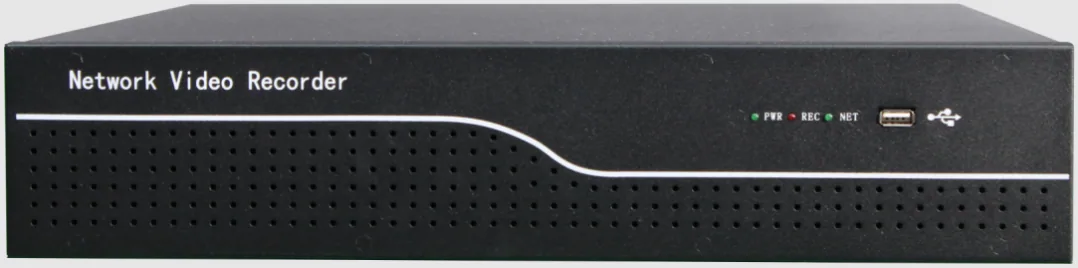
- 64 channels
- 8 bays up to 18 TB each
- Up to 144 TB raw capacity
- One management platform
When one recorder beats three
A large site can be recorded by several smaller recorders or by one 64-channel chassis. Several recorders isolate failures, but they also multiply the number of devices to log into, back up and maintain. A single 64-channel unit with eight bays keeps one user list, one playback interface and one backup process, which is worth a great deal to the person who has to find footage at two in the morning.
Use the 64-channel chassis when the site is administered as one property — a campus, a large warehouse and yard, or a multi-building commercial development. Split into separate recorders when the buildings are separately managed or when a network link between them is unreliable.
Capacity and how to use it
Eight bays at 18 TB each give 144 TB of raw capacity, which is enough for sixty-four 5 MP channels at full settings for well over a month, or a longer policy on a subset. Very few sites fill all eight bays at installation — the usual progression is to populate four bays and leave the rest for growth as retention requirements tighten.
Plan the drives as a set rather than one at a time. Mixing drive ages and sizes in a recorder makes replacement planning harder, and a failed drive in a set bought together is usually replaced under the same support arrangement.
The network is now the critical path
At sixty-four channels the recorder is no longer the bottleneck — the network is. Camera streams arriving from several switches have to converge on the recorder's ports, and that aggregate is what determines whether frames are dropped silently.
Plan the topology deliberately: switches per floor or per building, cascaded over SFP fibre to a core next to the recorder, with the camera traffic separated from management traffic. Where the camera count per building is large, give each building its own uplink rather than chaining buildings together.
Model
NVR64-8-2
flagship64 channels, 8 drive bays up to 18 TB each, up to 144 TB raw.
- Channels
- 64
- Drive bays
- 8, up to 18 TB each
- Raw capacity
- Up to 144 TB
Eight SATA bays. Plan the drive set and the network topology together.
Technical specifications
NVR64-8-2 technical specifications
| System Structure | Embedded LINUX, pure hardware decoding, Watchdog, HDMI HD display |
|---|---|
| Video Input | 64-channel HD IPC access; supports dual-stream, auto-search, and auto-add |
| Access Bandwidth | 320Mbps |
| Video Decoding | H.265+ / H.265 / H.264 |
| Local Playback | Supports 4-ch (4K @ 30fps) local playback |
| HDMI Output | HDMI 1: Supports 4K (3840×2160), 2K, 1080P, etc. HDMI 2: 1080P (Heterologous with HDMI 1 / Homology with VGA) |
| VGA Output | 1-ch VGA; supports up to 1920×1080 resolution |
| Layout Mode | 1 / 2 / 4 / 6 / 8 / 9 / 10 / 16 / 24 / 25 / 36 / 64 screen layouts |
| Recording Res. | 4K / 5MP / 4MP / 3MP / 1080P / 960P / 720P |
| Audio Interface | 1* 3.5mm 4-pin jack (In/Out); 1* 3.5mm 3-pin jack (In) |
| Audio Processing | G.711 standard; supports AV sync, dual-way audio, and Seetong remote audio |
| HDD Interface | 8 SATA Interfaces*; Supports up to 18TB per disk |
| External Storage | 1 eSATA interface*; Support for external USB HDDs and U-disks for backup |
| AI Smart Detection | Supports: Face, License Plate, Humanoid, Vehicle, High-altitude Parabolic |
| Alarm Linkage | Supports Motion Detection, IO Alarm, and AI-triggered recording |
| User Management | Supports up to 38 local users |
| Network Interface | 2 RJ45 10/100/1000M Self-adaptive Gigabit Ethernet Ports* |
| Protocols | TCP/IP, IPv4, DHCP, NTP, RTSP, P2P, SMTP, GB28181, ONVIF |
| USB Interface | 1* USB 3.0 (Rear); 1* USB 2.0 (Front) |
| Power Supply | AC 100~240V (50/60Hz) ATX Professional Power Input |
| Power Consumption | < 8W (Excluding Hard Disks) |
| Reliability | Lightning protection and anti-static design |
| Dimensions | 441 * 365 * 71mm (W * D * H) |
| Weight | Approx. 5700g (Net weight without HDD) |
| Environment | Temp: -10℃ ~ +55℃; Humidity: 10% ~ 90% |
Specifications are taken from the manufacturer data sheet for the model listed. Where a figure depends on the configuration you order, we confirm it in writing on the quotation rather than leaving it implied.
Frequently asked questions
One 64-channel recorder or four 16-channel recorders?
One chassis when the site is managed as one property, because you keep one user list, one playback interface and one backup process. Separate recorders when the buildings are separately managed, when a network link between them is unreliable, or when you want a failure in one building to leave the others recording.
How much can eight bays actually hold?
Eight bays at up to 18 TB each gives 144 TB of raw capacity. That covers sixty-four 5 MP channels at full settings for more than a month, or a longer retention policy on a subset of channels. Most installations populate half the bays initially and add drives as the requirement grows.
Does a recorder this size need a rack?
It belongs in a rack in a secure room with ventilation, together with the core switch. At this scale the equipment is a system rather than a box on a shelf, and the room it lives in matters as much as the equipment — heat and dust are the two most common causes of premature failure.
What is the network requirement at this channel count?
The recorder aggregates every stream, so the network becomes the critical path. Use a core switch next to the recorder, fibre uplinks from each building or floor over SFP, and separate camera traffic from management traffic where possible. Check the aggregate before assuming a single copper uplink will carry it.
Can it be managed together with smaller recorders?
Yes. All models in this range share the same firmware platform and client, so a site can run a 64-channel chassis in the main building and smaller recorders in outbuildings while keeping one management approach. That is often the better architecture for a campus.
How do I plan the transition from an older system?
Keep the existing cameras where they are, add the new recorder, and migrate channels in a controlled sequence rather than all at once. Because the recorder accepts ONVIF, RTSP and GB28181, cameras come across without being replaced. Read the NVR migration page for the sequence and the things that do not carry over.
Plan Your CCTV or Video Wall Project
Send us the building type, floor count and camera estimate — we will come back with a system layout, a bill of materials and a price.