Quote comparison case
CCTV System Cost Comparison: Two Quotes, One Building, One Bill of Materials
Two suppliers quoted the same hotel project in Africa. Our quote, dated 22 August 2026 on EXW terms, listed 221 cameras, 20 switches, 4 recorders, 19 floor cabinets and the whole CAT6 and fibre run. The tier-one quote listed 145 cameras, a platform server with 147 licences and a far larger storage build, but no switches, no cabinets and no cabling. The two scopes are not the same, so the totals are not a clean multiple and we do not present the case as one. What it does show is where the money actually goes, so this page breaks it into four sources and explains how to verify any quote — including ours.
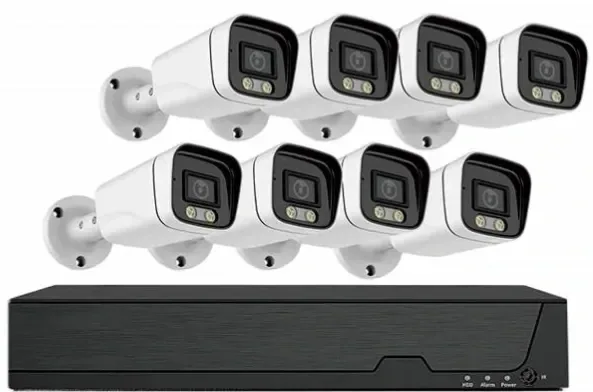
- One device list, one date, two quotes
- The gap is explained by four sources, not by one discount
- A two-column line-by-line appendix on request
- Verification method included — use it on our quote first
The case: one list, two quotes
A hotel project in Africa went to two suppliers, and both quotes are in front of us. Ours, dated 22 August 2026 on EXW terms, listed 221 cameras, 20 switches, 4 recorders, 19 floor cabinets and the full CAT6 and fibre run. The tier-one quote listed 145 cameras, a platform server with 147 licences and a far larger storage build, but no switches, no cabinets and no cabling. Two numbers from different scopes are not a comparison on their own, so what we publish is the two configurations side by side rather than the two totals.
We are not naming the other manufacturer, and we are not suggesting anything about its equipment. The point of this page is not who quoted what. It is why two prices for one list can sit that far apart, and what you should do with that knowledge when you are holding a quote of your own. The first reaction to a gap like this is usually “the cheap one must be worse”. Sometimes that is true. Usually it is not, and the four explanations below are the reason.
A project quote comparison we can share on request — configuration and date in the appendix — is one project, not a survey, and we present it as one project. What travels to your building is the method, not the number.
One rule governs everything on this page: we publish our own specifications and pricing; we do not publish claims about other manufacturers’ products that we cannot document. So there are no defect stories here, no anonymous failure rates and no screenshots of anyone else’s interface — only our specification, our price, and the structure of the gap.
A number on a page proves nothing. Ask for the appendix, read it against the quotes you hold, and use the verification method at the end of this page on us first.
The four sources of the difference
Almost every large gap between two quotes for the same list comes from the same four places. Understanding them turns a suspicious number into a checklist.
- Brand premium is not a scandal. It is what a name is worth in a market, and it buys real things: a global service organisation, documented roadmaps, a purchasing department that will approve it without questions. The test is whether those things are in your requirement. If they are not, you are paying for them anyway.
- Agent layers are the most common source of a gap, and the hardest to see, because each entity is legitimate and each margin is small. But four layers of 15 per cent is not small by the time it reaches your site, and on a big list it compounds with every item.
- System binding is where a comparison usually stops being like for like without anyone noticing. A controller, a licence or a matched drive does not look expensive on its own line; across a building it can be a meaningful part of the total, and it is the part you can never buy from anyone else.
- Scope definition is the one that catches buyers out. Two quotes described differently are two different jobs. Align them before you compare totals, and put the exclusions in writing on both sides. A wired design against a wireless one, or a colour specification against an infrared one, is not two prices for one system — it is two different systems, and comparing the totals tells you nothing until the designs match.
| Source | What it looks like on paper | How to test it |
|---|---|---|
| Brand premium | The specification is comparable item by item, but one carries a name that buyers recognise, and recognised names price accordingly | Ask what the same specification would cost with the brand removed from the decision, and what in the warranty actually depends on the name |
| Agent layers | Factory to national distributor to regional reseller to installer. Every layer carries a margin, plus the cost of credit terms and local stock | Ask who the quote is really from, and how many entities sit between the factory and your site. Every layer is a line you are paying for |
| System binding | Mandatory controllers, channel licences, activation steps and matched accessories that have exactly one possible supplier | List every item on the quote that cannot be bought from anyone else, then price what happens if you reuse what you already own or buy elsewhere |
| Scope definition | Wired against wireless, who does the civil work and the cable runs, whether drives and enclosures are included, and how long the warranty runs | Lay the two scopes side by side and mark every exclusion. A cheaper quote that excludes the cable is not cheaper — it is incomplete |
What the two-column comparison looks like
The appendix that accompanies our quote is a table, one row per line item, two price columns side by side, with the same currency and the date both quotes were issued at the top. Lines are grouped in the order the system is built: cameras by position, PoE switching, cabling and accessories, recorders and drives, display and client, then service and warranty.
It carries three extra columns that matter more than the prices. The first marks whether a line is like for like or a different specification, so a cheaper camera is visible as a cheaper specification rather than a cheaper camera. The second marks scope: who supplies it, who installs it, whether it is inside the price or excluded. The third is a note column for anything that needs a sentence — a substitution, a model change, a difference in warranty term.
The equipment side of that list is reproduced below, line by line, because it is the part that explains the difference. Per-line prices stay in the appendix itself: ask for it, and read it against the two quotes you already hold. We identify the other quote by configuration and date rather than by name, because the analysis does not need it.
If you would rather run the exercise on your own project, send us the bill of materials and we will return the two-column version with our price in the second column and the scope differences marked.
The equipment list, line by line
This is the equipment side of the case, taken from the two quotes themselves. Quantities are as each quote listed them; where a line says not listed, that quote did not carry it. Per-line prices stay in the appendix rather than on this page.
- Read the two columns against each other before the totals. The camera count differs by 76 units, and the cabling, cabinets, optics and the platform licence line appear in one column only — which is why the two totals are not a like-for-like ratio.
- Every figure above traces to a document: the proforma invoice behind our column, dated 2026-08-22, and the other quote as issued. Ask for both and read them against the buildings they were written for.
| System layer | Our bill of materials | What the other quote listed |
|---|---|---|
| Cameras | 221 in total — FC5B bullet 62, FC5D dome 156, FC5P-PTZ speed dome 3 | 145, model categories not stated |
| PoE switching | 20 switches, mixed 8, 16 and 24 port, allocated per floor cabinet | Not listed |
| Fibre and optics | 40 SFP modules | Not listed |
| Cable | 30 boxes of CAT6 | Not listed |
| Backbone | 70 m of 48-core single-mode fibre, 40 LC patch leads, 20 ODF | Not listed |
| Cabinets | 1 × 42U main cabinet, 19 × 12U wall cabinets | Not listed |
| Recording and storage | 4 × 64-channel recorders; storage priced in two tiers, one month and three months | A larger storage build; channels, bays and capacity not stated |
| Platform and licences | No proprietary platform: ONVIF / RTSP / GB28181 on the camera side | Platform server plus 147 licences |
| Totals | Two storage tiers, one month and three months, on our quote dated 2026-08-22, EXW; totals with the appendix on request | One total and no date on the document; the figure is in the appendix on request |
How to verify our quote, and theirs
This method works in both directions, and we expect it to be used on us. Send the same list to both suppliers, in the same structure, and insist on the same five answers: minimum illumination in colour mode, channel count against camera count, drive bay count and total capacity against retention days, exactly what the labour scope excludes, and the warranty term and what it covers.
Then do the physical checks. Ask what the PoE wattage total is, and what it is against the cameras quoted, because undersized switching is the most common hidden cost in a commercial system. Ask how many metres of cable are in the quote and whether the run lengths were walked or assumed. Ask who pays the freight, who pays the return freight on a failed unit, and how long a replacement takes to arrive. Ask how long the price holds, because a quote that expires in thirty days in a rising market is not the price you will pay.
Finally, ask for sample footage from a comparable scene, and take it. If a supplier cannot show you what the camera does at night on a site like yours, the specification is the only thing you are buying, and the specification is the easiest part of a system to write favourably.
How to use this in a decision
Do not buy the row; buy the outcome. What you are actually purchasing is a working system that identifies what happens on your site for the next five to seven years, and that includes the parts nobody quotes as a headline: the cable in the wall, the drives that will be replaced once, the spare camera for the unit that fails in year three, and the time your team spends learning a platform.
Work out the cost of the outcome over the life of the system and compare that instead of the sticker. Three questions usually sort it out. What does the system have to identify, and does each quote deliver that? What will it cost to keep running — storage growth, spares, support, renewals? And what happens on the day a camera fails: who ships, who pays, how long is the site blind?
Where the difference is genuine and the specifications match, the saving is a budget you can redirect to the parts that change outcomes: more PoE headroom, longer retention, better mounts, an enclosure where the camera is reachable, or a display in the guard room instead of a monitor in the cupboard. That is the useful version of a cost comparison: not cheaper for its own sake, but more system for the same money — or the same system for a number you can defend to whoever signs the budget.
Where we would tell you not to buy from us
A cost comparison that only argues one way is advertising. These are the cases where we say so before a quote is issued:
- Sites that require hazardous-area certification. Our range does not provide it, and no price advantage makes up for a document you cannot supply.
- Sites whose whole operation runs inside another platform’s ecosystem — licences, integrations, reports and workflows built around it. A cheaper bill of materials does not compensate for rebuilding an operation that already works.
- Estate-wide portfolios that require an in-country service company with a contractual response time. We support projects remotely, with local contractors doing the physical work, and if your tender requires more than that, we are not the right supplier for it.
- Buyers who need an OEM-branded mobile app for their own customers. Logo placement covers the carton, the case, the channel display page and the boot screen; the client application keeps its own name.
- Projects where the requirement is genuinely a name — for a landlord, a lender or an insurer whose approval process depends on it. That is a real requirement, and it is not one we can quote around.
Four ways to read a price difference
A cheaper specification
The most common assumption, and sometimes correct: lower resolution, smaller sensor, no enclosure, fewer drive bays. It is visible in the appendix if the specification column is filled in honestly, and it is a legitimate way to hit a budget.
- Use when
- Projects with a fixed budget where the requirement can be reduced deliberately, position by position, rather than by accident.
- Not when
- Where the requirement is identification at night. Cutting the sensor and the aperture is exactly the cut that removes the outcome being paid for.
A shorter scope
Cable, labour, drives, enclosures or commissioning left outside the number. The total looks better and the gap is filled by variations after the contract is signed — which is why exclusions matter more than totals.
- Use when
- Never as a strategy, but it happens in every market. Read the exclusions before you read the price.
- Not when
- Buyers who insist on a scope-aligned comparison, which removes the manoeuvre entirely and usually narrows the gap to something explicable.
A cheaper route to market
Fewer entities between the factory and your site, no name premium, no mandatory extras. The equipment may be comparable; what changes is how many margins sit on top of it and how much of the price is branding.
- Use when
- Projects where the requirement is a documented specification and a working system, and where the brand name is not itself a deliverable.
- Not when
- Tenders that require a recognised name, an in-country service organisation or an ecosystem the buyer has standardised on. Paying for those is not waste.
A different system design
Wired against wireless, colour against infrared, continuous against event recording. The quotes are not two prices for one system; they are two different systems, and comparing totals tells you nothing until the designs are aligned and both suppliers are answering the same requirement.
- Use when
- Sites where the requirement was never fixed in writing — the opportunity here is to write it down properly before the next round of quotes.
- Not when
- Comparisons where both suppliers quoted the same design and the same list. That is the only case in which a total is meaningful.
Frequently asked questions
How much does a commercial CCTV system cost?
A single figure without a specification is not a price, so we quote from the bill of materials and so should anyone else. It is the same question as “how much does video surveillance cost”, and it has the same answer. Six things decide the number: how many camera positions and at what resolution, how much PoE wattage and cable those positions need, how many recorder channels, how many days of retention those channels produce, how the footage is displayed and reviewed, and how much of the installation is in scope. Change any one and the total moves. This page exists because of exactly that problem: two suppliers quoted one hotel project, and the gap between them turned out to be mostly scope rather than margin. Send us your list and we will price the same list.
Why can one CCTV quote be far higher than another for the same building?
Four reasons, and they are all checkable: brand premium, the number of agent layers between the factory and the site, mandatory extras that bind a system to one supplier, and differences in what each scope actually includes. When you take a quote apart along those four lines, the gap usually becomes explicable rather than suspicious — and part of it may be legitimate, because a recognised name buys service infrastructure and an approval process that some projects genuinely require. The part that is worth challenging is the part nobody can document. Ask for the two-column appendix and read the specification and scope columns before you read the prices.
Is cheaper CCTV automatically worse?
No, and expensive is not automatically safer either. The specification is what decides, and the specification is checkable: resolution, sensor format, aperture, minimum illumination in colour mode, compression, PoE wattage, drive bays and warranty term. Two systems can match on every one of those and carry very different prices, because the difference is the name and the number of margins stacked on top. What we will not do is claim a technical advantage we cannot document, in either direction. Run the points on the verification list against our quote first, then against the one you are comparing it with.
Can you send us the two-column device list comparison?
Yes. A project quote comparison is available on request, with the configuration and the date in the appendix: one row per line item, two price columns in the same currency, and three extra columns marking like-for-like status, scope and any substitution notes. We identify the other quotation by configuration and date rather than by manufacturer, because the analysis does not need a name. If you want the same exercise run on your own project instead, send us the list you were quoted and we will return our priced version of it, with assumptions and exclusions marked, before you decide anything.
What currency do you quote in?
The case carries the two configurations rather than figures; the totals sit in the appendix that travels with the quotation on request, and our quote behind it is dated 22 August 2026 on EXW terms. We also state plainly where the two scopes differ — the tier-one list carried a management platform with 147 licences and a much larger storage build, ours carried every switch, cabinet and cable run — because a comparison with hidden scope differences is decorative rather than usable. When we quote your project, we quote in the currency you buy in and state how long the price holds. If your comparison involves two currencies, ask both suppliers for the rate basis and the validity period in writing, and keep the date on the record. A price is a fact about a moment, not a permanent property of a product.
How do I compare a wired quote with a wireless one?
You cannot compare the totals, because they are different designs with different failure modes. Compare what each has to deliver instead: power at every camera position, how the video gets back, what happens when the network or the power fails, who replaces batteries or consumables, and how much of the site has to be cabled anyway. A wireless design can be the right answer for a site where trenching is impossible, and a wired design at 100 m per run is the more predictable one where cable can be pulled. Choose the design first, then compare prices within it — and ask both suppliers to state the same retention period and the same camera count, or you are comparing two different buildings.
What should a warranty comparison cover?
Five things, and the years are only the first: how long the term runs, what it covers — unit only, or parts and labour — who pays return freight to and from the factory, how quickly a replacement is dispatched, and how long spares and firmware support are available after purchase. A three-year unit-only warranty on a camera at height can cost more in access equipment than the camera itself. Put both suppliers’ answers on one line and read them next to each other, because warranty is one of the four scope items that produce quote differences, and it is the one buyers most often leave unspecified.
Does a lower price mean lower specifications?
It can, and the only way to know is the specification column. Compare resolution, sensor format, aperture, minimum illumination in colour mode, compression, PoE wattage against camera count, drive bays and capacity, warranty term and what the scope excludes. Where those match, the difference is commercial rather than technical — a name, a distribution chain or an extras list. Where they do not match, the difference is real and you should decide whether the specification you are giving up was part of the requirement. Send us both lists and we will do that comparison with you, including the parts where our quote is the less complete one.
Send us the bill of materials you were quoted
We will price the same list and return a two-column comparison with the configuration, the date and the scope differences marked. If the difference turns out to be small, we will tell you that too.