Video wall · LED
LED Video Walls — When They Beat LCD
LED gives a seamless image, no bezels and high brightness. It also costs more per pixel. Here is where that trade is worth making, and where it is not.
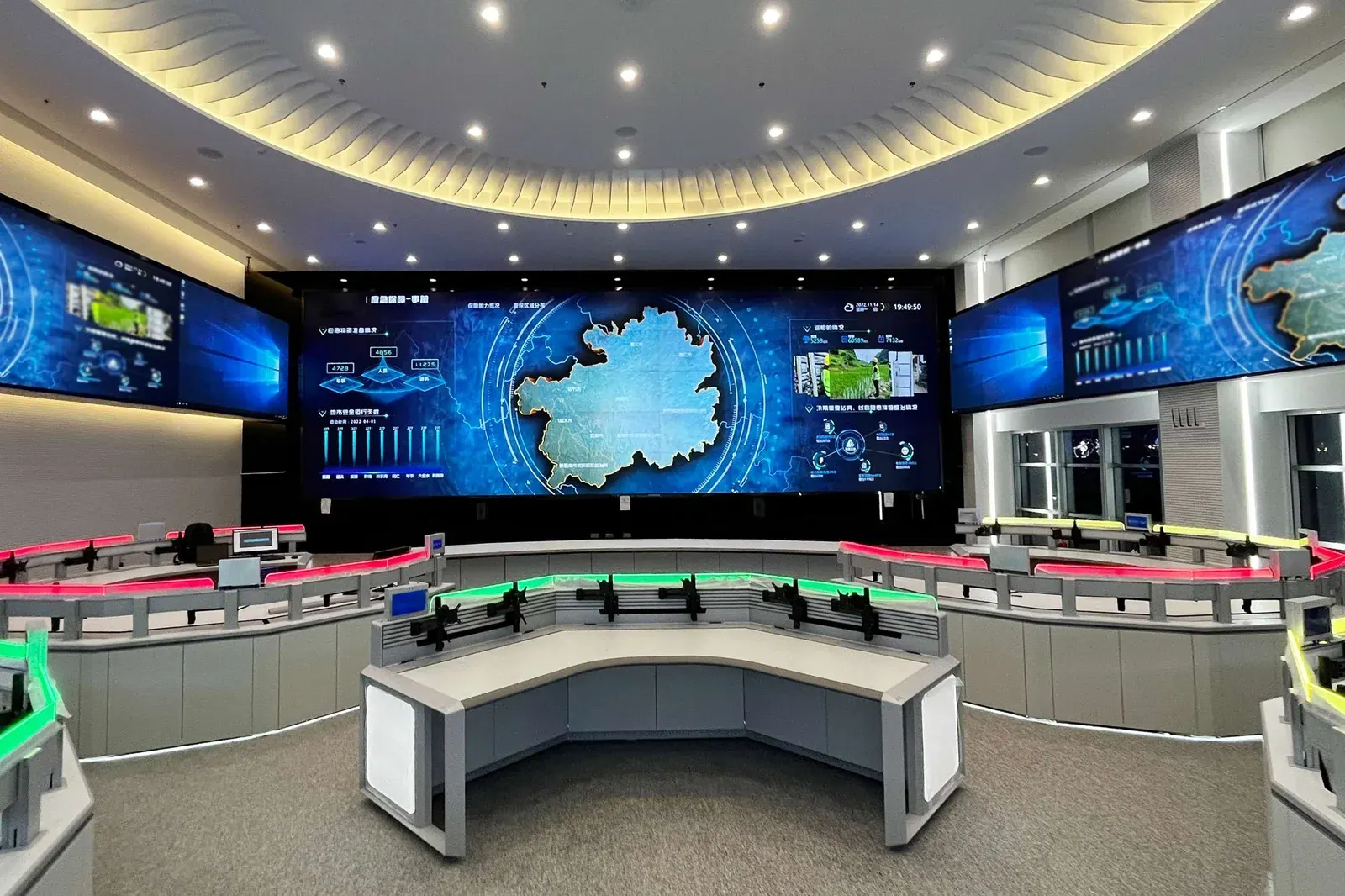
- Truly seamless image
- High brightness for bright rooms
- Pixel pitch sets viewing distance
- Driven by the same controller
When LED is genuinely the right answer
Outside those cases, LCD usually wins on cost per pixel and on text readability at close viewing distance. An LED wall in a small, dim control room where the operator sits two metres away is usually an expensive way to reduce sharpness.
- The wall must show one continuous image at large scale — a map, a schematic or a city overview with no interruptions.
- The room is bright, or daylight falls directly on the wall, and LCD panels wash out.
- The wall is very large, where the bezels of many LCD panels would multiply into an obvious grid.
- The wall is curved or an irregular shape, which panel-based displays cannot follow.
Pixel pitch decides the viewing distance
Pixel pitch is the distance between LEDs, and it sets how close a viewer can stand before the image breaks into dots. A finer pitch supports a closer viewing distance and costs more per square metre. A coarser pitch is cheaper and needs the viewer further back.
The practical method is to measure the distance from the nearest viewer position to the wall, then choose the pitch that holds up at that distance. Choosing the finest pitch available "to be safe" inflates the cost of a wall nobody will ever stand close to.
The signal layer is the same
Whatever the panel technology, the wall needs something to decide what appears where. Our video integrated management platform drives LED walls through the same modular chassis and 4K@60Hz decoding cards used for LCD, with IP cameras over ONVIF, RTSP and GB28181, recorder streams, analogue sources through encoders and computer inputs over HDMI and VGA.
That means the choice of panel technology does not lock you into a different control room workflow. Operators use the same keyboard and the same client either way.
Practical points that catch people out
LED walls run warmer than LCD and need ventilation behind the structure, which affects how the wall can be mounted in a room with limited void space. Service access matters more rather than less, because an LED wall is assembled from modules and a failed module has to be reachable from the front in most installations.
Brightness is adjustable and should be set to the room rather than left at maximum. A wall running at full brightness in a dim control room is tiring to work in front of for a full shift, and it shortens the life of the modules.
Frequently asked questions
What pixel pitch should be specified?
Pitch is chosen from the closest viewing distance, not from the room size. As a working rule, the pitch in millimetres should be no greater than the closest viewing distance in metres. A 3 mm pitch viewed from 2 m is right; from 8 m it is wasted money.
Indoor or outdoor specification?
They differ in brightness and sealing. An indoor panel viewed in a lit lobby needs far fewer nits than an outdoor panel facing direct sun, and an indoor-rated panel will not survive weather. Match the rating to where the wall is actually installed.
How is it serviced?
Front access or rear access, and that is a structural decision. Front-service modules can be mounted close to a wall; rear-service needs a walkway behind, which changes the room. Decide it with the architect before the wall is ordered.
What drives it, and what limits it?
A controller or decoding server, sized by stream count and output count rather than by panel area. LED adds no load to the network — the limit is still what the cameras and the recorder deliver.
Plan Your CCTV or Video Wall Project
Send us the building type, floor count and camera estimate — we will come back with a system layout, a bill of materials and a price.