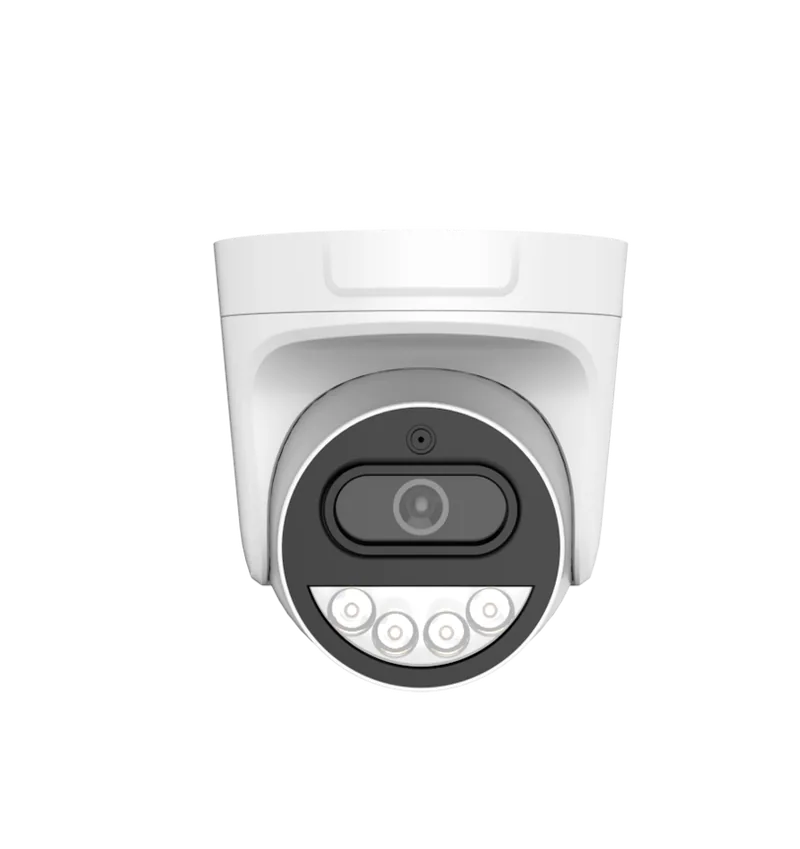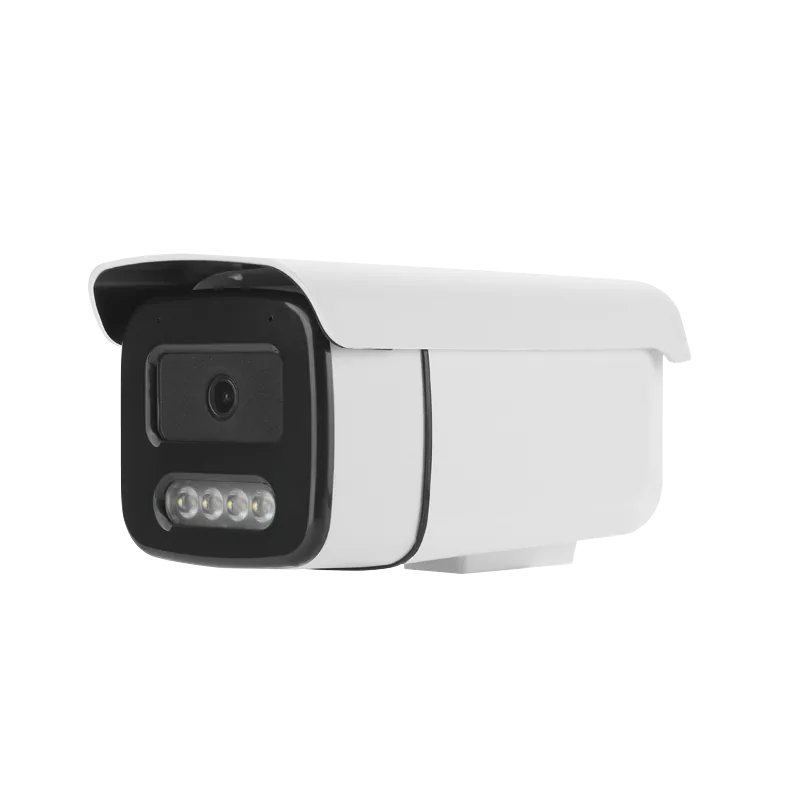
The dome against bullet question is usually answered with opinions about which looks better or which is more secure, when the honest starting point is that in our range the image is identical. The FC5D dome and the FC5B bullet are both built on the same 38 × 38 mm board-level module: 5.0 MP at 2880 × 1620 on a 1/2.7-inch low-light CMOS sensor at F1.0, colour to 0.1 Lux, H.265+ at 25 fps real time, one audio input and one output, the same detection features and the same red and blue warning light interface.
So the choice is not about picture quality. It is mechanical and behavioural: where the camera can be mounted, how it is aimed, how easy it is to interfere with, and how visible the site wants it to be. Those four questions decide the form far more reliably than a preference for one shape.
This article sets out what each form gives you, where each belongs in a commercial building, and where the honest answer is to mix them.
Why is the image not the difference?
Because both forms share the same module, both publish the same performance: 0.1 Lux in colour at F1.0, monochrome at 0 Lux with the illuminator, H.265+ with a main stream of 500–8000 kbps and a sub stream of 50–2000 kbps, a single 10/100 Mbps RJ45 port with 6 KV common-mode and 1.5 KV differential surge protection on the network, a DC 12 V 2 A input, an operating range of -20 °C to +55 °C, and ONVIF, RTSP, GB28181, DHCP and P2P over the network.
The consequence is useful in a tender: if a supplier quotes a dome at one resolution and a bullet at another for the same position, you are looking at two different products rather than two different shapes. In our range the resolution ladder — 5 MP at 2880 × 1620, 4 MP at 2560 × 1440, 3 MP at 2304 × 1296, 2 MP at 1920 × 1080 — is a configuration choice, not a consequence of the housing.
What does the dome form give you?
- Aim that is hard to read and hard to change. A dome gives no obvious indication of which way it is pointing, and it offers very little leverage to push it off target. In a lift car, a lobby or a corridor at shoulder height, that matters more than any datasheet line.
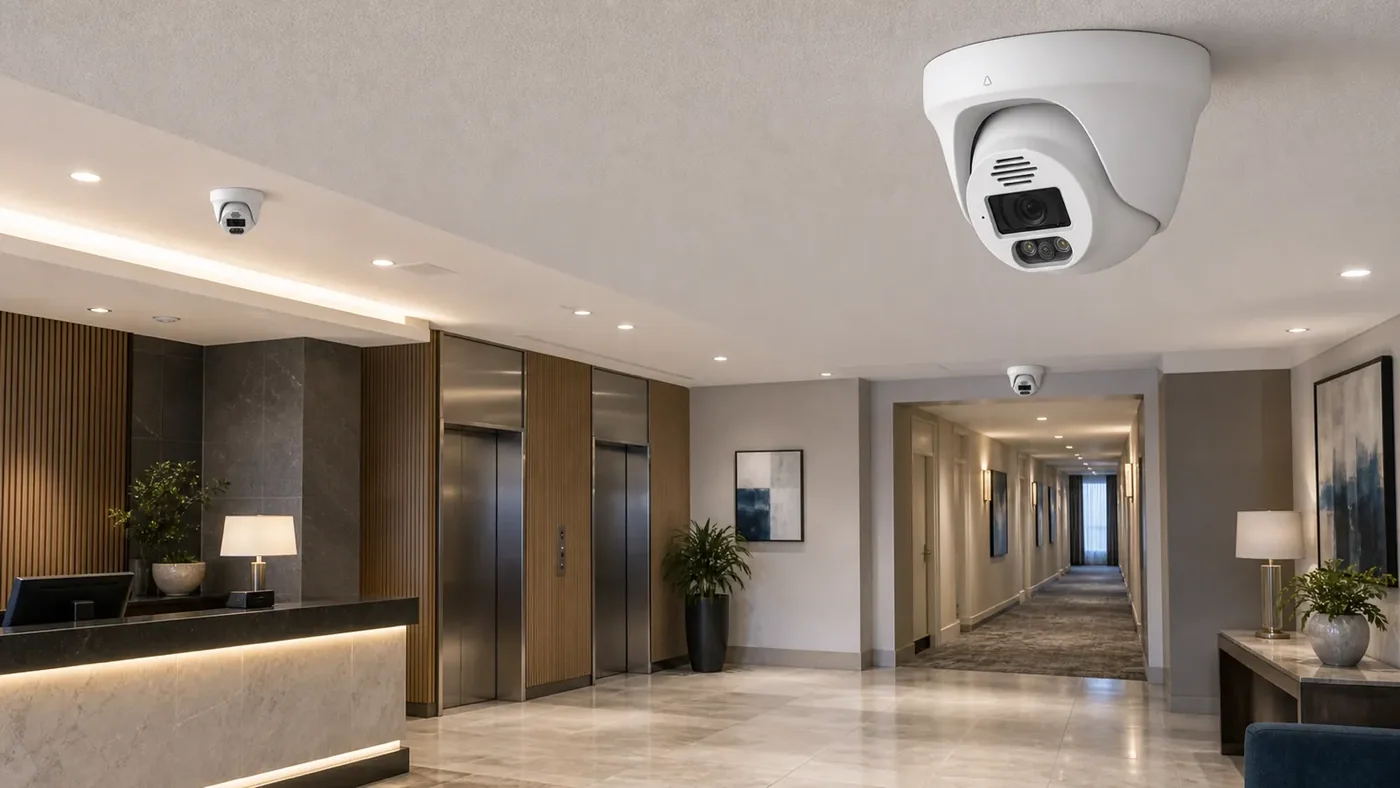
- Ceiling mounting in small spaces. A dome sits flat against a ceiling, so it works in a room where a bracket and a projecting body would be impractical or would be knocked.
- A less confrontational presence. In a reception area or a retail frontage, a dome reads as part of the building rather than as a piece of equipment aimed at customers.
- Two-way audio where people are. The module supports one audio input and one output with G.711 compression and an 8 Ω 2 W speaker, which is worth having at an entrance or a service counter where the camera form is a dome anyway.
The limitation is aiming. A dome is set once, at installation, and adjusting it later means opening the housing. That is fine for a room or a lobby, and it is the wrong choice for a long boundary where the aim may need to change with the site.
What does the bullet form give you?
- A clear direction, which is itself a deterrent. A bullet CCTV camera points visibly at its target, and people who notice a camera behave differently from people who cannot tell where it is looking. On a perimeter, a goods entrance or a car park ramp, the visible aim is doing work.
- Aim that can be adjusted without dismantling anything. A bracket allows the camera to be pointed and locked, and re-aimed later if the site changes — a fence moves, a gate is relocated, a ramp is re-routed.
- Mounting along a wall or a building line. Where the target is a straight run rather than a room — a façade, a boundary wall, a service lane — a bullet aimed along the line keeps the subject at a consistent angle instead of crossing the field of view quickly.
- Better thermal behaviour in direct sun. A bullet housing is shaped to shade and to shed heat rather than trap it under a ceiling, which is why the form is the usual choice outdoors in hot climates.
The limitation is exposure. A bullet is visible, its aim is readable and its bracket is within reach of anyone tall enough and bold enough. Where interference is a real risk, that is an argument for a dome or for a higher mounting point.
Which position suits which form?
| Position | Recommended form | Why |
|---|---|---|
| Main entrance and reception | Dome | Ceiling mount, no obvious aim, two-way audio available at the counter |
| Lift cars and lift lobbies | Dome, in a vandal-resistant housing | Hard to reach cleanly, hard to re-aim, and the position is exposed to deliberate interference |
| Corridors and stair landings | Dome | Flat mounting, wide view at a junction, no visible direction to avoid |
| Car park deck | Dome indoors, bullet outdoors | Ceiling structure supports domes below ground; open decks need a housing that sheds heat and rain |
| Ramp and entry lanes | Bullet | Aimed along the lane so vehicles stay at a consistent angle rather than crossing the view |
| Loading bay and goods entrance | Bullet with the warning light interface | Visible aim at the point where vehicles stop, and the warning light is switched deliberately |
| Perimeter and building line | Bullet | Long straight runs, aiming adjusted as the site changes |
| Plant rooms and stores | Either | Coverage of a fixed area; choose whichever suits the ceiling and the cable route |
Where does the 38 × 38 mm module matter?
Both forms are board-level modules of 38 × 38 mm, and the honest consequence is that neither carries an IP rating. We do not publish a dust or water figure for the module because there is not one to publish. Protection outdoors or in a dusty space comes from the housing the module is fitted into, and that is a decision to make per position rather than per order.
Three practical points follow. An outdoor position needs a housing that is specified for the site, and we will tell you plainly what a given housing does and does not cover. The working temperature range of the module itself is -20 °C to +55 °C, so ventilation or shading is a real design consideration in an enclosed housing in direct sun. And the module’s surge protection — 6 KV common mode and 1.5 KV differential on the network, 1.5 KV on power — protects against electrical events, not against water ingress or physical interference.
Which three questions decide it?
- What must this position prove? Identification at a doorway wants the camera looking along the direction people approach, at a shallow angle, so faces rather than the tops of heads are recorded. A dome in a ceiling looking steeply down sees movement beautifully and faces poorly, which is a reason to move the position rather than to change the form.
- How accessible is the camera? If a person can reach it, stand on something and push it, the dome form usually wins. If the mounting point is high, wall-mounted and out of reach, the bullet’s bracket is not a weakness.
- Should the site see it? A visible camera shapes behaviour, and a bullet aimed down a lane advertises coverage in a way a dome does not. Where deterrence is the point, choose the form that points; where the goal is to observe without confrontation, choose the form that does not.
Most commercial buildings end up with both, and there is no penalty for mixing them: the two forms share the same configuration, register on the same recorder over ONVIF, RTSP or GB28181, and are reviewed in the same client. Keep the resolution and frame-rate settings consistent across the site so the retention calculation stays honest.
Send us the positions you are unsure about and we will mark which form suits each one, including the ones where the answer is to move the camera rather than to change it. Housings, brackets and the vandal-resistant options are quoted with the camera so the comparison is like for like.