Colour night vision vs infrared — CCTV comparison
Colour Night Vision vs Infrared Security Cameras: What Changes After Dark
Infrared is the default answer to darkness, and in total darkness it is still the right one. What is rarely written down is the two-part cost: infrared light produces a monochrome file, and the illuminator shows anyone in the yard exactly where the camera is. This page sets out where each approach fits, what the file can prove in each case, and the three specification numbers to compare before you buy.
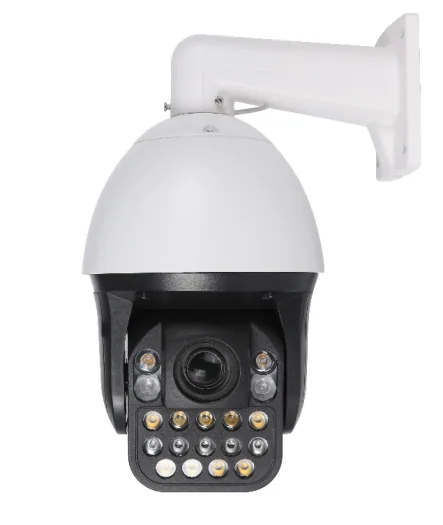
- Infrared: an image in total darkness, always monochrome
- Full colour: colour to 0.1 Lux at F1.0, no illuminator glow
- The trade-off is light, not brand
- Mixed systems are normal — match the approach to the position
The short version
Infrared and full colour night vision answer two different questions. Infrared answers “is there something there”, and it answers it in complete darkness, at range, from a camera with no ambient light to work with. Full colour answers “what exactly was there”, and it answers it in colour, from a camera that does not have to light the scene to produce an image.
The choice is decided by three things at each camera position: how much light the position has after dark, whether the camera may be visible, and what the recording will have to prove. Get those three right and the technical selection is straightforward. Get them wrong and you either pay for colour you cannot use, or you end up with a monochrome file you cannot identify anyone from.
Why infrared footage is always black and white
Infrared night vision works by removing the IR-cut filter from the light path. That filter normally blocks infrared so the sensor sees roughly what the eye sees. Remove it, add an infrared illuminator, and the sensor receives plenty of light in total darkness — that is the strength of the approach.
But red, green and blue are separated at the sensor by colour filters, and those filters pass very little infrared. So the sensor records brightness faithfully and colour hardly at all. The camera therefore writes a monochrome image, and it does so because of physics rather than a menu setting. There is no processing step that puts the colour back, because the colour was never captured in the first place. That matters in review: a witness can describe a dark jacket, and the file will never disagree, but it will never help either.
The second cost: an infrared camera lights itself up
An infrared illuminator is a lamp. It is invisible-ish to the eye at short range but it is not invisible to a person standing in the yard looking for the camera: the LED array glows, and the glow is a fixed point in the dark. On a site where deterrence is the goal, that is a feature — the camera is visibly watching. On a site where you would rather not advertise the coverage, it is a cost that does not appear on any datasheet.
Full colour night vision inverts that. There is no illuminator running on ambient light, so there is nothing to see; the camera becomes a small dark shape like every other piece of street furniture. The red and blue warning light on the FC5 series is a separate, controllable interface, so visible deterrence is a choice you switch on deliberately rather than a side effect of seeing in the dark. Its light board is driven by two PWM channels at 24 kHz, which keeps the warning light flicker-free on camera.
What a colour file proves that a monochrome file cannot
- Vehicle colour, and which of two similar vehicles was involved — the detail that matches a vehicle to a gate log, a fuel record or a witness statement.
- Clothing colour and pattern, which is how a guard, a supervisor or a police officer describes a person to someone else in real time.
- The colour of carried objects: a bag, a container, a tool, a package. Monochrome turns all of them into grey shapes.
- Consistency between the night file and the daytime file for the same position, which makes a sequence of events easier to assemble and present.
- The colour of a spill, a flame, a chemical container or an indicator light — sometimes the fastest way to understand what happened.
Colour is an additional dimension on the record. It does not replace resolution, frame rate or lighting; it simply stops the file from throwing information away.
The three numbers to compare
| Specification | What it decides | Full colour series |
|---|---|---|
| Minimum illumination in colour mode | The darkest scene in which the camera still records colour instead of switching to monochrome | 0.1 Lux at F1.0 |
| Aperture | How much light reaches the sensor at a given sensor size; the lower the f-number, the more light | F1.0 |
| Sensor format | How much light-gathering area sits behind each pixel, and therefore how clean the night image is | 1/2.7-inch low-light CMOS |
| Frame rate at night | Whether the night stream is real time or quietly reduced, which changes what fast movement looks like | 25 fps real time, adjustable 7–25 fps |
An infrared camera will also publish a minimum illumination figure — 0 Lux, with the illuminator on. That 0 Lux is real, and so is the monochrome image that comes with it.
Where infrared is still the better answer
We are not going to pretend infrared is obsolete. It is the correct specification in several common situations, and a well-designed building usually contains both approaches:
- Total darkness with no lighting plan and no prospect of one — an unlit boundary, a rear service lane, a field edge. Nothing beats an illuminator where there is no other light.
- Long-range detection, where the objective is to see that someone is moving along a line rather than to identify them. An illuminator plus optical zoom is a strong combination.
- Deterrence-driven sites where a visible camera is part of the point, and the glow is doing useful work.
- Storage-constrained sites where a monochrome stream keeps the recording period inside the drive budget without buying more bays.
- Positions where a light would be noticed or would cause complaints — though this cuts both ways, because the illuminator is itself visible.
Three ways to combine the two on one site
Infrared at the boundary
The perimeter is where distances are long, lighting is absent and the job is detection. An infrared camera with optical zoom covers far more metres per device than any fixed colour camera, and the monochrome file is a fair trade for the range.
- Use when
- Boundary lines, unlit rear lanes, yards measured in tens of metres and positions where only movement matters.
- Not when
- Gates and vehicle entrances where people and plates have to be identified rather than detected — those want colour close in.
Full colour where people are identified
Gatehouses, staff entrances, loading bays and car park decks are where identification happens and where an incident becomes a statement, an insurance claim or a court case. These are the positions worth spending the colour budget on.
- Use when
- Car parks, entrances, loading areas, corridors and any position where a face, a vehicle or an object has to be described.
- Not when
- Sites with no ambient light at all where the camera must stay unnoticed, because the fill light is visible light.
Both, on one recorder and one bill of materials
The two approaches are not rivals in a design; they are two answers to two different positions. Both register on the same recorder over ONVIF / RTSP / GB28181, both run H.265+, and both are configured and reviewed in the same client.
- Use when
- Most commercial buildings, where perimeter detection and entrance identification are separate requirements in the same tender.
- Not when
- Buyers who want one camera model everywhere for the simplest possible maintenance story — mixing forms costs a little more design time up front.
Frequently asked questions
Is colour night vision better than infrared?
Not in general — it is better for a specific job. If the camera has to identify a person, a vehicle or an object, colour carries information that a monochrome file does not have, and it does it without a visible illuminator. If the camera has to cover a long dark boundary at distance in total darkness, infrared plus optical zoom will out-perform any fixed colour camera, and the monochrome file is the accepted cost. The useful question is not which technology wins; it is what each position has to prove, and how much light that position has after dark. Answer those honestly and the choice usually makes itself.
Does infrared really reveal where a camera is?
At night, yes, in most practical installations. The illuminator is a light source, and light sources are visible at the distances that matter for a camera that exists to watch a yard. Someone who wants to avoid a camera will look for the glow, and it also tells them the coverage stops where the illuminator stops. On a site where the camera is meant to be seen, that is useful deterrence. On a site where you would rather not publish the coverage, it is a weakness, and it is the reason colour cameras that run on ambient light are chosen over infrared for entrance and forecourt positions.
Can colour be recovered from infrared footage afterwards?
No. The colour was never recorded. Infrared night vision removes the IR-cut filter and lights the scene with infrared, and the colour filters on the sensor pass almost none of that light, so the sensor writes brightness and almost no colour information. Restoring it would mean inventing it, which is exactly what an “enhanced colour” filter does — it guesses plausible colours from brightness, which is fine for a presentation thumbnail and useless as evidence. If a file may end up in a statement or a claim, capture the colour at the camera or accept that the file does not contain it. There is no honest post-processing route.
How far can a full colour camera see at night?
Any distance figure without a lighting condition next to it is meaningless, so we will not give you one. The number that decides it is minimum illumination: our series holds colour to 0.1 Lux at F1.0, which covers a lit car park, a street-facing forecourt or a corridor with a night light. What that means in metres depends on the lens, the mounting height, whether the target is a person, a face or a plate, and how much light the site itself provides. Send us the position and its lighting, and we will tell you what to expect — including when the honest answer is a PTZ with an illuminator, and monochrome at night.
Which approach costs less to run and store?
Infrared costs less storage: a monochrome stream carries no chroma, so at the same resolution it uses less bitrate, and a site with fourteen days of retention may fit the same drive with either approach while a sixty-day retention may not. Colour costs less on the lighting bill in some sites, because a camera that holds colour on ambient light does not need a floodlight running for it. Both of them cost less than guessing wrong. Budget the recording period first, then choose the approach per position, and let the arithmetic — roughly 8 to 15 GB per day per 5 MP channel at H.265+ — decide how many bays you need.
Can I mix infrared and colour cameras on the same recorder?
Yes. Both are IP cameras on the same network and both register on the same recorder over ONVIF, RTSP or GB28181; the recorder does not care which illumination the camera uses. What you should keep consistent is the configuration layer: the resolution ladder (5 MP at 2880 × 1620, 4 MP at 2560 × 1440, 3 MP at 2304 × 1296, 2 MP at 1920 × 1080), the compression setting, the frame rate and the retention plan. That way one channel is not quietly eating four times the storage of the others. We will lay out the mixed plan on the drawing so the installer knows which position gets which form.
What should I write in the specification to avoid getting monochrome?
Put three numbers in the specification and require them in colour mode: minimum illumination, aperture and sensor format. Ours are 0.1 Lux at F1.0 on a 1/2.7-inch low-light CMOS sensor. Then add two sentences that protect you: that the quoted camera must hold colour in the lighting conditions at the named positions, and that sample footage from a comparable scene will be provided before delivery. A specification written that way cannot be answered with a vague sensitivity claim, and it gives you a documented basis for a conversation if the delivered system behaves differently from the brochure.
Compare the two approaches on your own positions
Send us the site plan and the positions you are unsure about. We will mark which ones suit full colour, which suit infrared, and what each choice does to your storage budget. Sample footage is available on request.