Colour vs starlight — CCTV night vision
Colour Night Vision vs Starlight CCTV Cameras: Where the Light Limit Sits
Starlight is not a component; it is a threshold, and it describes how much residual light a sensor can still work with. Full colour night vision is the same idea pushed further down the light scale, and it comes with a number you can compare: 0.1 Lux at F1.0. This page sets out what starlight means, how the two behave as the light drops, and how to settle the choice on a building CCTV system with a measurement instead of a preference.
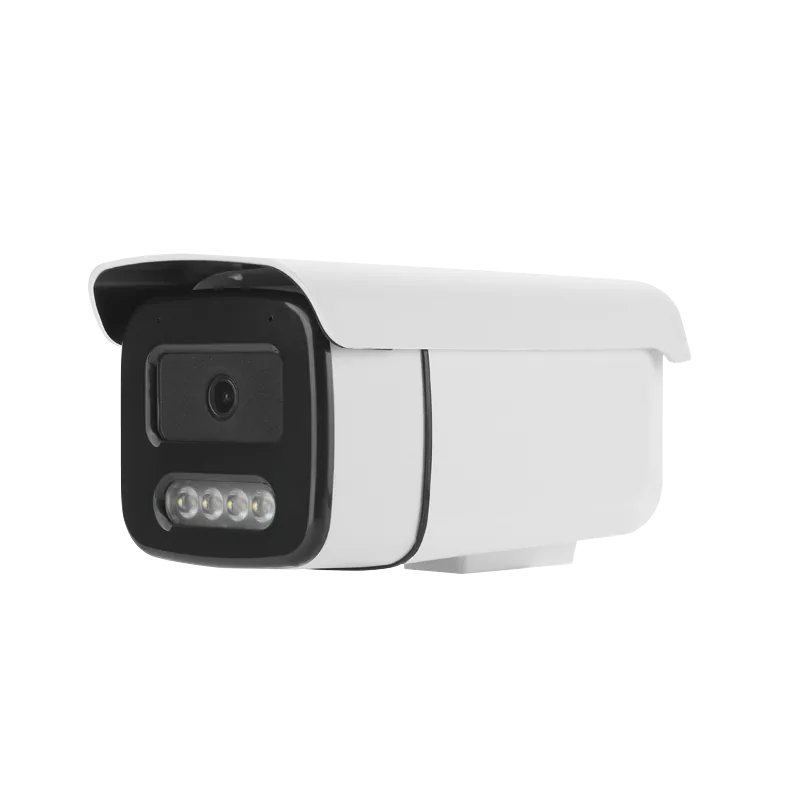
- Starlight: colour while residual light lasts
- Full colour: colour specified down to 0.1 Lux at F1.0
- Both fall back to infrared below their threshold
- The only fair comparison is minimum illumination in colour mode
Same idea, different threshold
Starlight and full colour are not competing technologies. Both keep the IR-cut filter in the light path, both record colour, and both stop recording colour when the light falls below their limit and the camera falls back to infrared. The difference is where that limit sits, and whether the manufacturer will state it as a number you can put in a specification.
That is why this decision is easier than it looks. You are not choosing between two philosophies; you are checking whether a camera’s colour threshold is below the light level your site actually has at the hours you care about. If it is, you get colour. If it is not, you get monochrome and an illuminator glow, no matter which tier name is printed on the box.
What starlight actually describes
Starlight is a sensitivity tier, not a sensor type. It says that under a small amount of ambient light — the kind a street, a neighbouring building or a dusk-to-dawn lamp provides — the sensor still produces a usable image, and on a colour-capable model that image can be in colour. It is a genuine capability, and for a lot of sites it is entirely sufficient.
The catch is that a tier name is not a measurement. There is no standard that fixes what “starlight” means, so two cameras sold under that word can sit at quite different light levels. The only way to compare them is to ask for the same figure from each: minimum illumination in colour mode, in Lux, at a stated aperture. A datasheet without that number is not something you can compare, and that is a statement about the document rather than about the camera.
Our own colour row is 0.1 Lux at F1.0, with a 1/2.7-inch low-light sensor behind it. Ask for the same row from any camera you are considering, in colour mode, and the comparison becomes arithmetic.
The numbers that decide it, and what happens below them
| Item | What it tells you | Full colour series |
|---|---|---|
| Minimum illumination in colour | The darkest scene where colour survives | 0.1 Lux at F1.0 |
| Aperture | How much light reaches the sensor at that sensor size | F1.0 |
| Sensor format | How much light-gathering area sits behind each pixel | 1/2.7-inch low-light CMOS |
| Below the colour threshold | What the camera does when colour is no longer possible | The built-in illuminator contributes light; the datasheet also publishes black and white at 0 Lux with the illuminator on |
| Frame rate | Whether the night stream is real time or reduced | 25 fps real time, 7–25 fps adjustable |
Both rows matter. A camera that publishes only the 0 Lux monochrome row has told you where it ends up, not how long it stays in colour.
Your lighting plan decides which one you need
Before comparing cameras, measure the position. A simple lux meter reading, taken at the hours you care about and at the height the camera will be mounted, is worth more than any tier name. These are the situations we see most often:
- Car parks with bollard or soffit lighting on all night: plenty of residual light, and a colour camera holds colour without any illuminator running.
- Forecourts and street-facing entrances with spill from road lighting: usually enough, and the position where colour matters most because that is where vehicles and faces appear.
- Perimeters lit by dusk-to-dawn lamps: fine while the lamps are on. Ask what happens if the site switches them off to save power, because that decision quietly converts your colour system to monochrome.
- Yards and rear service areas with a single security light on a motion sensor: the light is off most of the night, which is exactly when the camera needs it. Either add a dusk-to-dawn fixture at that position or accept a fallback to monochrome outside the light window.
- Corridors and stairwells with a night light: low but steady, and well inside a 0.1 Lux colour specification.
The storage bill follows the same line
Two colour cameras at the same resolution can still produce different storage loads, because more detail and more usable light produce more motion and more bitrate at the same settings. Plan from the recorded figure rather than the camera name: one 5 MP channel at H.265+ uses roughly 8–15 GB per day depending on how much crosses the frame, and a sixteen-channel system at thirty days lands around 4–7 TB.
The recorder range gives you room to plan it: single-bay 10- and 16-channel models at up to 14 TB per drive, and 32, 49 and 64-channel models with two, four and eight bays at up to 18 TB per drive, all with H.265+ and a 64 Mbps access bandwidth. If you want 60 or 90 days of colour retention, decide that before the recorder model is fixed, because adding bays later is a new box rather than a new setting.
How to settle it on your own site
Measure the light at the position with a meter at the hours that matter, and write the reading next to the camera schedule. Then ask for the colour minimum illumination figure of every camera you are comparing, at a stated aperture, and check which ones sit below your measured level. Ours is 0.1 Lux at F1.0 — if your reading is above that, the camera should hold colour without the illuminator.
Sample footage is available on request, and it is the second half of the same test. A Lux figure tells you whether colour is theoretically available; footage from a comparable scene tells you what the picture looks like when a person walks through it. Ask for both, from any supplier, and you will not have to take a tier name on trust.
Send us the measured Lux reading, the mounting height and the hours you need on record, and we will tell you whether the position holds colour all night or needs a lighting change. Sample footage is available on request.
Starlight, full colour and where each one gives up
Starlight tier
A starlight sensor is comfortable where the site never goes fully dark — street lighting, neighbouring buildings, lamps that stay on. It is a sound, economical choice, provided the datasheet states its colour threshold so you can check it against your site.
- Use when
- Lit car parks, urban forecourts, residential streets and corridors where residual light is reliable all night.
- Not when
- Sites where the lighting is switched off after a certain hour, or where the only fixture is on a motion sensor and is off precisely when the camera needs it.
Full colour at 0.1 Lux
The same principle with a lower threshold and a published number. It keeps colour in the dimmest conditions a colour sensor can realistically work in, and it does so without an external lamp or the camera firing its own white LEDs.
- Use when
- Car parks, forecourts, entrances, loading bays and stairwells where identification matters and some ambient light exists.
- Not when
- Sealed or genuinely unlit positions where the built-in illuminator has to add light, and sites where any visible light at the camera defeats the purpose.
Infrared as the fallback
Below any colour threshold, a dual-mode camera falls back to infrared and the file becomes monochrome. That fallback is not a failure — it is the layer that keeps an image coming when colour is no longer possible, and it is why the design still works on the worst night of the year.
- Use when
- Every position that must produce an image in conditions worse than its colour threshold, including power cuts and lighting failures.
- Not when
- It should never be the only layer on a position that has to identify people or vehicles, because the file it produces on those nights is monochrome.
Frequently asked questions
Is starlight the same as full colour night vision?
They are the same principle with different thresholds. Both keep the IR-cut filter in place so the sensor records colour, and both fall back to infrared when the light drops below their limit. Starlight describes a tier that works under a modest amount of ambient light; full colour night vision is specified further down the scale, with the threshold stated as a number — ours is 0.1 Lux at F1.0. The practical difference is not the name but whether the threshold sits below the light level your site actually has. If your position is dimmer than a camera’s colour threshold, you get monochrome and an illuminator, whatever the badge says.
Do starlight cameras work in complete darkness?
No colour camera does — that is a limit of the sensor, not of the tier. In complete darkness a starlight camera falls back to infrared and records monochrome, assuming it has an infrared illuminator. If it has no illuminator, the image is simply unusable. This is the single most useful thing to understand before comparing tiers: the marketing language describes the good end of the range, while the specification row describes the boundary. Ask what the camera does below its colour threshold, and ask for the Lux figure at which that happens, so you can plan for the worst night rather than the average one.
What does 0.1 Lux look like on a real site?
It is dim — roughly the light from a distant street lamp or a corridor night light, well below a lit car park and far below a working area. The practical way to use the figure is to measure your own positions: take a lux meter reading at the camera height at the hours you care about, and compare it with the colour threshold of each camera you are considering. If your reading is above 0.1 Lux, a full colour model should hold colour without its illuminator. If it is below, plan for the illuminator, or plan a lighting change at that position, and put the decision in writing so nobody is surprised at handover.
Which one should I specify for a car park?
Measure first, then decide per deck rather than per building. A surface car park with lighting on all night has plenty of residual light, so a colour camera holds colour with no illuminator running. A basement or an unlit top deck a few hours after closing may drop below the threshold, and there the choice is between adding a dusk-to-dawn fixture, accepting the built-in illuminator, or specifying infrared and monochrome at those positions with colour kept at the entrances and ramps. That mixed plan is what we usually recommend, and it is the one that keeps the storage and lighting budgets honest.
Can I compare a starlight datasheet with yours fairly?
Yes, but only on figures both sheets publish. Ask for minimum illumination in colour mode, in Lux, with the aperture stated — that is the one row that makes the two comparable, and ours is 0.1 Lux at F1.0. Then ask two supporting questions: the sensor format, because light-gathering area behind each pixel drives the night image, and the frame rate in night mode, because a reduced frame rate is sometimes used to make a low-light image look better than it behaves with movement. Where a datasheet has no colour Lux figure, you can still buy the camera, but you cannot compare it — and a comparison you cannot document is not a comparison.
What happens below 0.1 Lux on your cameras?
The built-in illuminator contributes light, and the datasheet carries the matching row: colour 0.1 Lux at F1.0, and black and white 0 Lux with the illuminator on. The camera also links the sensor, the IR-cut filter and the illuminator through an integrated driver, so the mode change is a configured behaviour rather than a guess. If a position on your site is genuinely unlit, tell us and we will specify that channel deliberately — illuminator, PoE budget and enclosure together — rather than leaving it to whatever the default setting happens to do on the first dark night.
Which is more expensive, starlight or full colour?
We price from the bill of materials rather than from a tier name, so send us the position list and we will quote it line by line. What we can say without your list is that a lower colour threshold costs more sensor and more aperture, and aperture is the part that costs real money in glass. The economical mistake is paying for full colour where a starlight camera would have been sufficient, or buying a starlight camera for a position that is dark for six hours a night. Measure the position, compare the thresholds, then buy the tier that actually matches — which is also the cheapest way to be right.
Send us your Lux readings, we will size the tier
Tell us the positions, the lighting at each one and the hours you need on record. We will confirm which cameras hold colour, which fall back, and what that does to your PoE and storage budgets. Sample footage is available on request.