Colour vs black and white — CCTV evidence
Colour vs Black and White Security Cameras: What the Footage Can Prove
Black and white is not a defect; it is a decision the camera makes, and on some sites it is the right decision. The question to settle before you buy is whether the file has to identify something or only show that something happened. This page is about that difference, what colour adds to a CCTV recording, and how to specify it honestly.
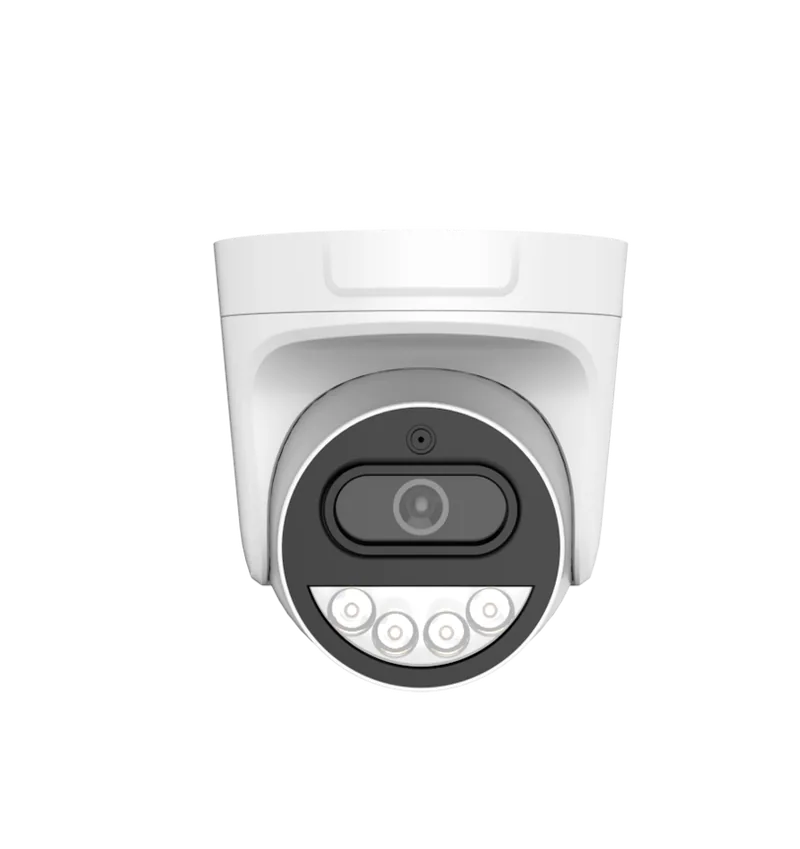
- Monochrome records brightness; colour records brightness and hue
- Colour to 0.1 Lux at F1.0 on the full colour series
- Monochrome is still correct for detection-only positions
- The recorder settings decide what is actually written to disk
The difference in one line
A black-and-white camera records how much light came back from the scene. A colour camera records how much light came back and what colour it was. Everything else on this page follows from that single difference, and so does every practical consequence: what a witness can describe, what a guard can pass on, and what a file can be used to prove months later.
There is a reason monochrome exists. Dropping colour makes a sensor more sensitive and a stream cheaper to store, and on a position where the only question is whether something crossed a line, that is a rational trade. The trouble starts when a monochrome decision is made by default — by a camera that was never specified for colour, on a position where identification turns out to matter after the incident, not before it.
What colour proves that monochrome cannot
- Vehicle colour and body style, which is how a registration number is matched to a log book, a fuel record or a driver statement.
- Clothing colour and pattern, which is how one person is distinguished from another in a corridor or a car park at night.
- The colour of a carried object — a bag, a rucksack, a box, a tool — which monochrome renders as one more grey shape.
- Material and condition cues: a hi-vis vest against a dark coat, a wet surface, a spill, a scorch mark, an indicator light.
- Continuity between the night file and the daytime file for the same position, which makes a sequence of events far easier to assemble and present.
Timestamps and channel names are overlaid on the image by the camera OSD, so a colour file also carries the basic context needed to say where and when it was recorded.
When monochrome is genuinely the right call
We will say this as plainly as we say the opposite: several positions in a normal building should be monochrome, and specifying colour everywhere is not good engineering.
- Long perimeter runs where the objective is detection: someone crossing a line, a vehicle stopping where it should not. Colour adds nothing to a silhouette at that distance.
- Positions with no ambient light and no possibility of adding any, where an illuminator plus monochrome is the only configuration that produces an image at all.
- Storage-limited sites. Monochrome uses less bitrate than colour at the same resolution, and that difference buys retention days when the drive bays are already fixed.
- Sites where the recording is used for operations rather than evidence — a loading bay sequencing check, a gate queue, a plant room log.
How to specify colour without over-promising
Ask for three numbers in colour mode: minimum illumination, aperture and sensor format. Ours are 0.1 Lux at F1.0 on a 1/2.7-inch low-light CMOS sensor. A camera specified this way holds colour in a lit car park, a street-facing forecourt or a corridor with a night light, without an external lamp and without firing its own white LEDs.
Then state the limit in the same document, because a specification that admits its boundary is more useful than one that does not. Below 0.1 Lux the built-in illuminator has to contribute light, and the datasheet carries both rows: colour 0.1 Lux at F1.0, and black and white 0 Lux with the illuminator on. Ask us to confirm which configuration applies to each position rather than assuming.
Finally, put a number on the consequence. Colour at night costs storage, and it should be planned on the same sheet as the cameras: one 5 MP channel at H.265+ uses roughly 8–15 GB per day, so a colour-at-night system with thirty days of retention and sixteen channels lands around 4–7 TB before any headroom. If that is too much, the honest options are fewer retention days, a lower resolution on selected channels, or monochrome on the detection-only positions.
The recorder settings decide what is written to disk
A colour-capable camera and a colour file are not the same thing. The recorder decides which stream it writes, at what resolution and frame rate, and whether the channel runs continuously or on motion. It is entirely possible to buy full colour cameras and store monochrome video, because somebody set the channel to record the monochrome sub-stream to save space, or set night mode to black and white to buy retention days.
That is worth checking in any comparison you are holding. Ask what resolution and stream each channel records, how many days the drive actually holds at your motion levels, and whether the night mode on each channel is set to colour or monochrome. Our recorders publish a 64 Mbps access bandwidth, HDMI output at 4K 3840 × 2160 and VGA at 1920 × 1080, and a 1/2/4/6/8/9/10/16 split layout, so the review experience is there — but the stream settings are what your file will actually contain. Set them deliberately.
Sub-streams are configured separately at 50–2000 kbps against the 500–8000 kbps main stream. The sub-stream is what a phone client usually shows, so check it too if guards review on mobile.
Where the conversation actually lands
Nobody buys a camera for a court case. They buy it because something happened and they want to know what. The test we suggest to buyers is simple: imagine the incident you are most likely to have — a vehicle in the yard at 1 a.m., a person in the stairwell, a delivery that went missing — and ask whether the file you are specifying would let you describe the vehicle, the person or the item. If the answer is a colour, specify colour on that position. If the answer is a time and a direction of travel, monochrome will do.
That test usually ends with a mixed specification rather than a slogan, which is the outcome we would prefer. We would rather sell you eleven colour channels and five monochrome ones than eighteen channels you cannot use.
Three ways a building ends up in black and white
Monochrome by specification
The position is detection-only, the distance is long, and there is no lighting plan. An illuminator plus monochrome is the correct, economical answer, and nobody is pretending otherwise on the drawing.
- Use when
- Perimeter lines, unlit service yards, plant rooms and any position where a time and a direction of travel are the whole question.
- Not when
- Gates, entrances and payment areas, where a person or a vehicle will eventually have to be described rather than counted.
Monochrome by default
The camera simply does not hold colour in the available light, so it falls back to black and white at dusk and stays there. Nothing on the quote says so, and the buyer discovers it on the first night the system is needed.
- Use when
- It never applies as a design decision — it is what happens when colour performance is not written into the specification.
- Not when
- Anywhere the file may be used to identify someone. This is the case the three specification numbers exist to prevent.
Colour at night, by specification
The position has some light, the camera holds colour down to 0.1 Lux at F1.0, and the storage budget was sized for a colour stream rather than a monochrome one. That last part is what makes the specification honest.
- Use when
- Car parks, forecourts, entrances, corridors, loading bays and stairwells — the places where people and vehicles are close enough to identify.
- Not when
- Sites with genuinely zero ambient light where the visible fill light would defeat the purpose, and sites where the drive budget cannot be increased and retention matters more.
Frequently asked questions
Why do CCTV cameras switch to black and white at night?
Because black and white is easier to produce in low light. Dropping the colour channels makes a sensor more sensitive and the stream cheaper to store, so most cameras switch to monochrome at dusk unless the design prevents it. On cameras with infrared illumination the switch is compulsory — the IR-cut filter comes out so the infrared light can reach the sensor, and the colour filters pass almost none of it, so the image is monochrome by physics. A full colour camera keeps the IR-cut filter in place and stays in colour mode as long as there is enough light, which is what the 0.1 Lux colour specification describes.
Is black and white night vision worse than colour?
It is worse for identification and equal or better for detection. A monochrome file can tell you that a vehicle entered the yard at 01:14 and left at 01:31; it cannot tell you the vehicle was dark blue rather than dark green, which is the detail that matches a gate log or a statement. If the position exists to answer “what happened, and when”, monochrome is a sound, economical choice. If it exists to answer “who”, colour carries information that monochrome never had. We specify both on the same buildings, on different positions, because pretending colour is always right costs you storage you did not need to spend.
Can I force a camera to stay in colour at night?
On a camera that supports it, yes — including our FC5 series, which stays in colour down to 0.1 Lux at F1.0. But forcing colour on a camera that cannot gather enough light does not create information; it produces a dark, noisy, heavily-processed image that is worse as evidence than a clean monochrome one. The setting is only as good as the sensor, the aperture and the light at that position. If you want a position to record in colour all night, specify the light and the numbers together, then verify with sample footage from a comparable scene before the order is placed.
Does black and white save storage?
Yes. A monochrome stream carries no chroma, so at the same resolution and frame rate it uses less bitrate than a colour stream. As a working rule, a 5 MP channel at H.265+ uses roughly 8–15 GB per day in colour depending on how much motion crosses the frame, and monochrome sits at the lower end of that scale. On a sixteen-channel system, the difference over thirty days can be a few terabytes, which is exactly the kind of figure that decides whether one drive bay is enough. Plan retention first, then choose which channels need colour, and the arithmetic usually settles the debate.
Will colour footage be accepted as evidence?
We are not qualified to give legal advice, and we do not try. What we can tell you is what the file contains: colour carries more information about the scene than monochrome, alongside the timestamp and channel name overlaid by the camera OSD. How a court, an insurer or an employer treats a recording is a matter for their rules and for your procedures — retention period, who has custody, whether exports are logged. Our part is to make sure the file that reaches that process has not thrown away information at the sensor, which is the one failure that cannot be fixed afterwards.
What should I do if I already bought monochrome-capable cameras?
First, check what they can actually do — many cameras have a colour mode that was never enabled because the default saves storage. Second, check the recorder: the channel may be writing the monochrome sub-stream while the camera is producing colour. Third, if the camera genuinely cannot hold colour in that position, the fix is at that position only. Most buildings have two or three positions where identification matters most, and those can be changed without touching the rest of the system, because everything registers on the same recorder over ONVIF, RTSP or GB28181.
Which camera forms give us colour at night?
Three: the FC5B bullet, the FC5D dome and the FC5P-PTZ speed dome, all 5 MP at 2880 × 1620 with the same 1/2.7-inch low-light sensor and F1.0 aperture. The bullet and the dome are 38 × 38 mm board-level modules, so an enclosure and bracket are specified for the mounting position — and where the camera sits within reach, that enclosure should be an anti-vandal type. The PTZ is a finished speed dome for wide-area coverage. Because all three share one platform, a mixed installation is one configuration and one client rather than three separate systems.
Check which positions need colour on your site
Send us the floor plan or the camera positions you already have. We will mark which ones should record colour at night, which can stay monochrome, and what each choice does to your retention. Sample footage is available on request.