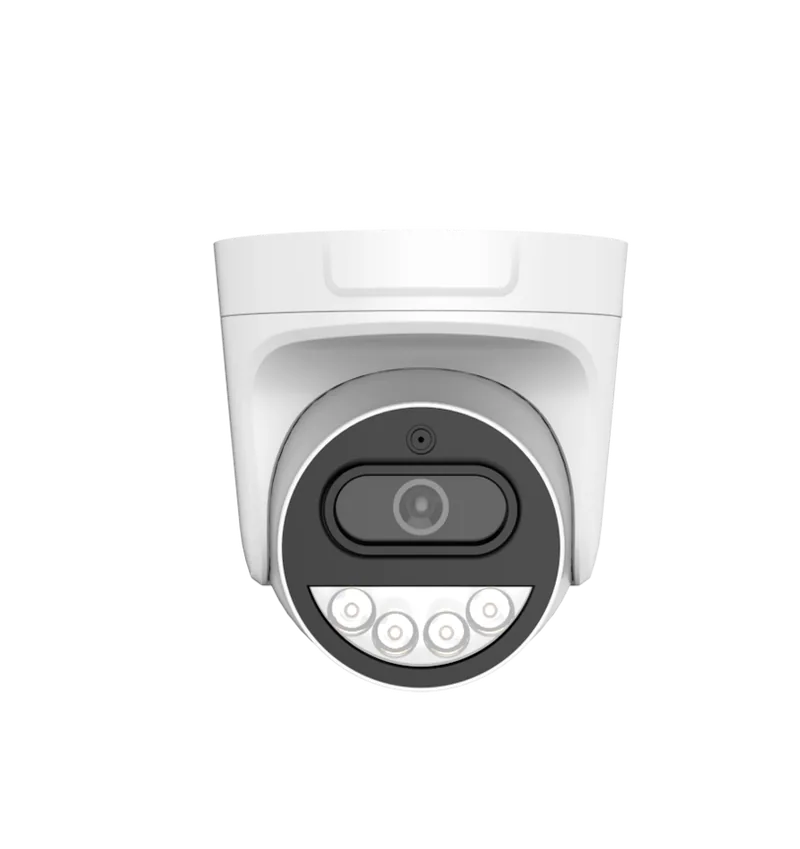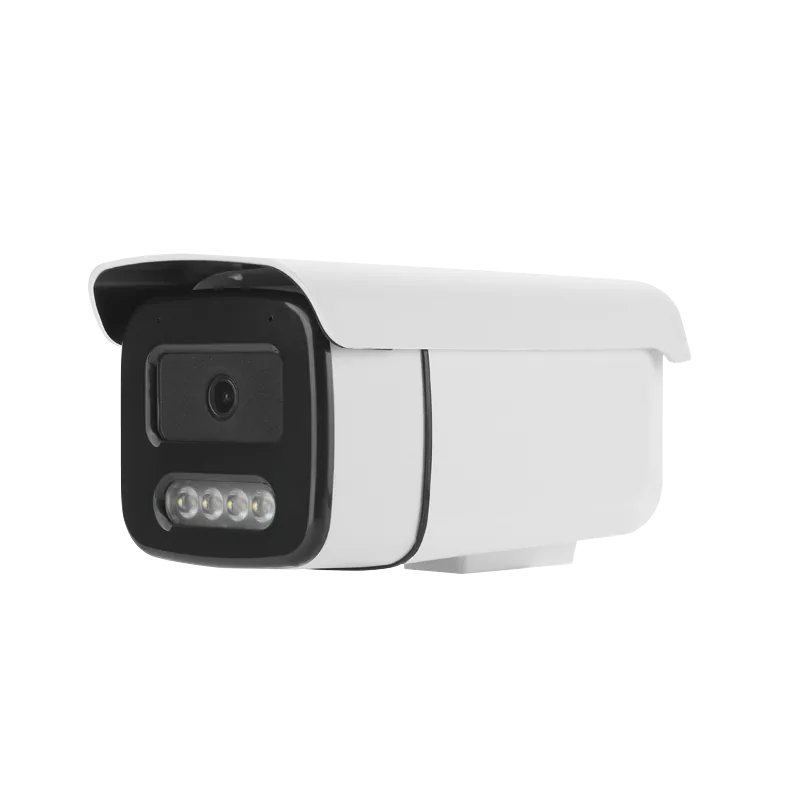
Black and white night vision is neither a failure mode nor a cheap camera. It is what happens when a camera moves its IR-cut filter out of the light path and lights the scene with infrared, and it is a deliberate design with a specific strength: it produces an image in darkness where nothing else will. The useful question is narrower and more commercial. When a recording ends up in a witness statement, an insurance claim or a hearing, what does a monochrome file fail to provide, and what does the colour version cost in bitrate and storage?
The short answer: monochrome records brightness, and brightness is enough for detection but not for description. Colour carries the extra dimension that lets one person describe an event to another — clothing, vehicle colour, the colour of a carried object, the colour of a flame or a spill. Our 5 MP range holds colour to 0.1 Lux at F1.0 and switches to monochrome at 0 Lux with the illuminator on, so the choice between the two is a lighting decision at each position rather than a product tier you buy into.
Two numbers settle most of the argument in a tender: the minimum illumination in colour mode, and the retention period the site must keep. The first decides whether you get colour where it matters. The second decides what it costs to keep it.
Why does a camera record black and white at night?
In daylight the IR-cut filter blocks infrared so the sensor sees roughly what the eye sees, and colour filters over each pixel site separate red, green and blue. Night vision moves the filter out of the light path and adds an illuminator, and the sensor then receives plenty of light in what looks to a person like complete darkness. That is the strength of the approach.
The catch is physical. The pixel colour filters pass very little infrared, so the sensor records brightness faithfully and colour hardly at all. The camera writes a monochrome image because of how the sensor is built, not because of a menu setting, and no processing step restores the colour, because the colour was never captured. Our cameras manage the transition through an integrated ICR driver that links the sensor, the IR-cut filter and the fill light, so the switch happens at a configured low-light threshold rather than arbitrarily. The published figures are 0.1 Lux in colour at F1.0 on a 1/2.7-inch low-light CMOS sensor, and 0 Lux in black and white with the illuminator running.
What can a monochrome file not tell you?
Every item in this list is something a witness can describe from a colour file and cannot be supported by a monochrome one:
- Vehicle colour, and therefore which of two similar vehicles passed a gate at 22:40 — the detail that links a camera file to a gate log, a fuel record or a driver’s statement.
- Clothing colour and pattern, which is how a guard, a supervisor or a police officer describes a person to somebody else in real time, over a radio, while the event is still happening.
- The colour of carried objects: a bag, a container, a tool, a package. Monochrome reduces all of them to grey shapes of similar size.
- The colour of a spill, a flame or an indicator light — often the fastest way to understand what went wrong and whether an area is safe to enter.
- Consistency with the daytime file from the same position, which makes a sequence of events across a full day easier to assemble and present.
Colour is not a replacement for resolution, frame rate or a well-chosen position. It simply stops the file from discarding information it could have kept.
What does colour cost in bitrate and storage?
Colour costs nothing at the camera when the position has enough light; it costs storage. A colour stream carries chroma information that a monochrome stream does not, and our main stream runs at 500–8000 kbps against 50–2000 kbps on the sub stream. The arithmetic that turns that into a drive purchase is short:
GB per day per channel × channels × retention days ÷ 1024 = terabytes required
A 5 MP channel at H.265+ usually lands between 8 and 15 GB per day depending on movement and scene. Thirty days of that across a building looks like this:
| Channels | 30 days at 8 GB/day | 30 days at 15 GB/day | Bays needed |
|---|---|---|---|
| 16 | 3,840 GB — about 3.8 TB | 7,200 GB — about 7.0 TB | One bay: 14 TB covers both ends |
| 32 | 7,680 GB — about 7.5 TB | 14,400 GB — about 14.1 TB | One 18 TB bay at the low end; two bays at the high end |
| 64 | 15,360 GB — about 15.0 TB | 28,800 GB — about 28.1 TB | One 18 TB bay at the low end; two at the high end |
The per-bay ceilings are 14 TB on the 10 and 16-channel recorders and 18 TB on the 32, 49 and 64-channel models, with one to eight bays depending on the model. That is why retention is a design decision rather than a purchase at the end: moving from 30 to 90 days triples the storage requirement, and no camera choice gives that back.
Where is colour actually decided in the evidence chain?
An incident travels a predictable path: it happens, a camera records it, somebody reviews the file, a statement is written, and a claim or a hearing is decided. Colour is decided at the first step and cannot be added later.
A file can only describe what the sensor recorded. Nothing downstream adds information to it, and “enhancement” that invents plausible colours is not evidence.
This is why the argument belongs position by position rather than technology by technology. A building needs colour at the entrance, the lift lobby, the car park deck and the loading bay, where people and vehicles are identified. It may be perfectly served by monochrome at an unlit boundary where the requirement is to know that something moved along the fence line at 02:15. Both can register on the same recorder over ONVIF, RTSP or GB28181, both record in H.265+, and both are reviewed in the same client.
Where is monochrome still the right answer?
- Total darkness with no lighting plan and no prospect of one, where an illuminator is the only thing that produces an image at all.
- Long-range detection along a boundary, where distance matters more than detail.
- Deterrence-driven sites, where a visibly active camera with a glowing illuminator is doing the job on its own.
- Storage-constrained sites where a fixed retention period has to fit a fixed drive budget.
How do you specify colour that is actually delivered?
Put three numbers in the specification and require them in colour mode: minimum illumination, aperture and sensor format — 0.1 Lux at F1.0 on a 1/2.7-inch low-light CMOS sensor in our case. Then add two sentences that protect the project:
- The quoted camera must hold colour in the lighting conditions at the named positions, at the frame rate specified — 25 fps real time, adjustable from 7 to 25 fps.
- Sample footage from a comparable scene will be provided before delivery, and the camera will be tested at the position rather than in a corridor at head office.
If a position has no light after dark, be honest about it in the design rather than in the specification. Either the site provides light, or the camera records monochrome, or the drawing changes to put a camera where it can see something useful. All three are legitimate answers; only the fourth, promising colour in a scene with no light, is not. Send us the positions you are unsure about and we will mark what each one can realistically deliver after dark.