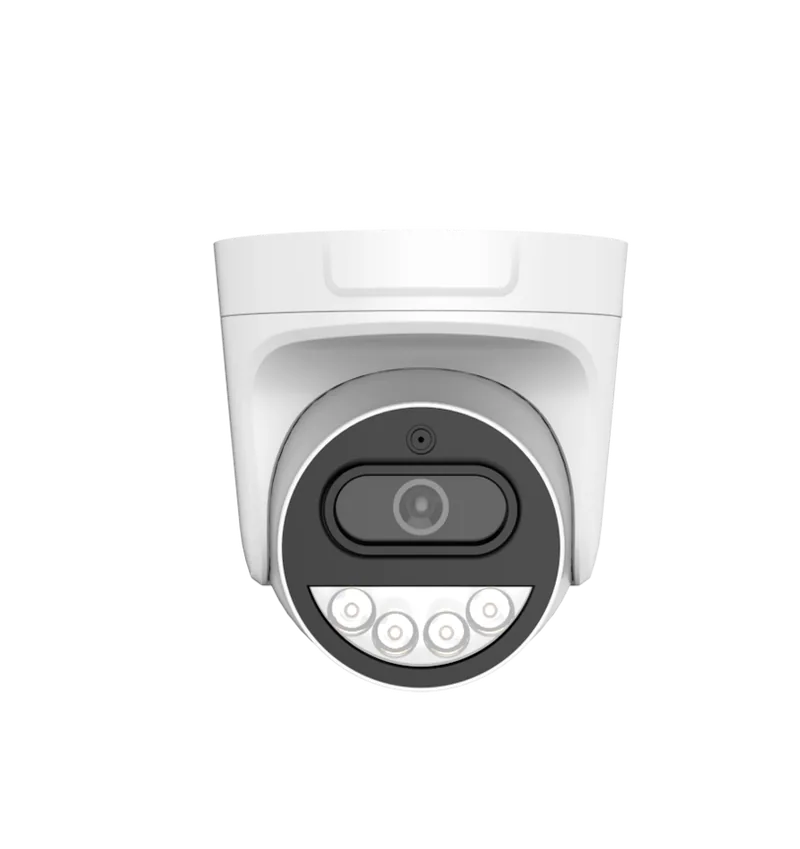
Starlight is one of the most used and least defined terms in CCTV. It is not a technology and it is not a standard; it is shorthand for a camera that produces a usable image in very low light, and different suppliers fill that shorthand with different engineering. Comparing full colour night vision with starlight is therefore not a comparison of two products. It is a comparison of three published numbers and one question about light sources, and if a quote answers those, the exercise takes ten minutes.
Here is the short version. A low-light claim is only meaningful with four things next to it: minimum illumination in colour mode, aperture, sensor format, and whether the camera uses infrared or white light when it does need help. Ours are 0.1 Lux in colour at F1.0 on a 1/2.7-inch low-light CMOS sensor, with monochrome at 0 Lux when the illuminator takes over.
One more thing worth saying plainly: colour is not free and it is not magic. It is a light budget. A camera that holds colour at 0.1 Lux does so because a fast lens and a low-light sensor gathered what light was there. Where there is no light at all, something has to provide it, and what provides it changes the site as much as the camera.
What is “starlight” actually describing?
When a specification says starlight, it usually means the camera is sensitive enough to produce a recognisable image under very low ambient light — moonlight, spill from street lighting, or a distant lamp. In practice that claim is delivered by three engineering choices: a sensor with larger photosites, so each pixel collects more light; a fast lens, so more light reaches that sensor; and image processing that trades a little noise for colour retention. Suppliers weight those three differently, which is exactly why the word on its own cannot be compared.
What the term does not tell you is the light level at which the camera gives up on colour and switches to monochrome. That threshold is the number that decides what your file looks like at two in the morning, and it is usually the number missing from the marketing line.
Which four numbers sit behind any low-light claim?
| What the claim needs | What it decides | Our published figure |
|---|---|---|
| Minimum illumination in colour mode | The darkest scene in which the camera still records colour rather than switching to monochrome | 0.1 Lux at F1.0 |
| Aperture (f-number) | How much light reaches the sensor at a given sensor size; the lower the number, the more light | F1.0 |
| Sensor format | How much light-gathering area sits behind each pixel, and therefore how clean the night image is | 1/2.7-inch low-light CMOS |
| Illumination method below the threshold | Whether the camera lights the scene, and with what: infrared produces monochrome with almost no visible glow, white light produces colour and is plainly visible | Monochrome at 0 Lux with the illuminator on, below the colour threshold |
A quotation that lists minimum illumination without aperture and sensor format cannot be compared with one that lists all three. That is the whole reason this article exists.
Where do full colour and starlight actually differ?
Two differences matter commercially, and neither is about image quality as such.
The first is where the threshold sits. A starlight claim is a claim about sensitivity; a full colour claim is a claim about the light level at which colour survives. If a supplier says starlight and cannot state a colour-mode lux figure, you cannot know whether the camera holds colour in your car park in winter or quietly switches to monochrome at 18:30.
The second is what the camera does when the threshold is crossed. Some designs add white light and keep colour; some add infrared and go monochrome. Both are legitimate, and they produce completely different files and completely different site conditions. White light preserves colour and is visible, so it lights the yard and your neighbours will notice. Infrared produces a monochrome file and is far less visible to the eye, though it is still a lamp in the dark to anybody looking for it.
Why is a quoted lux figure a problem?
Minimum illumination figures are quoted at a defined light level with a defined aperture, and they are frequently the least comparable numbers on a datasheet. Two cameras can both claim 0.01 Lux and behave completely differently, because one is quoting a monochrome figure with the illuminator on and the other a colour figure with a fast lens.
Ask three questions of any figure: is it colour mode or black and white, at what aperture, and with the illuminator on or off? A figure that answers all three is comparable. A figure that answers none is a marketing sentence. Ours is easy to check: 0.1 Lux in colour at F1.0, 0 Lux in black and white with the illuminator running.
There is a further honest limit. Lux is measured at the sensor under a specified light source, so it says nothing about the lens, the mounting height, the size of the target or the shutter speed the camera chooses in a given scene. That is why a demonstration file from a position like yours is worth more than any datasheet comparison, and why we send sample footage on request.
When does the trade-off change for complete units and PTZ?
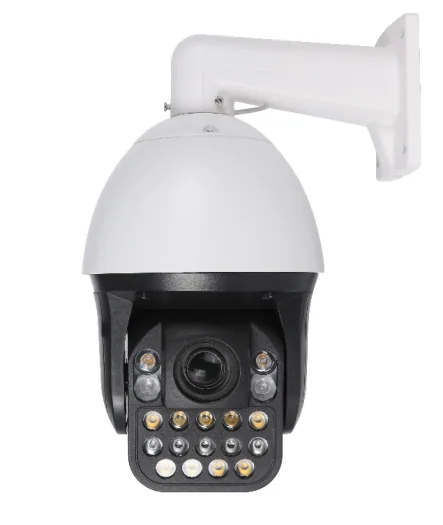
Fixed cameras and speed domes do not make the same trade-offs. The FC5P-PTZ is a complete outdoor unit rather than a board-level module: it carries its own housing, works from -20 °C to +55 °C, supports two-way audio through a 8 Ω 2 W speaker output with G.711 compression, and exposes the same red and blue warning light interface as the fixed cameras, with the light board driven by two PWM channels at 24 kHz so the warning light does not flicker on camera.
For low-light work, the practical advantage of a PTZ is that it can be pointed at the part of the scene where the light is, and follow an event rather than watching one fixed frame. The trade-off is the same as everywhere else in this article: the camera is only as good as the light it can find or add, and a PTZ that has to travel across an unlit yard at night is not better than a fixed camera. It is just busier.
What are the storage consequences of the choice?
A colour stream at night usually means a higher bitrate than the monochrome equivalent of the same scene, because chroma carries information. Our main stream runs at 500–8000 kbps and the sub stream at 50–2000 kbps, and the planning arithmetic is the one used everywhere else: GB per day per channel × channels × retention days ÷ 1024 = terabytes. A 5 MP channel typically sits between 8 and 15 GB per day at H.265+.
If the retention requirement is 30 days and the budget is tight, the honest options are to reduce retention, to reduce resolution on the channels that do not need 5 MP — the ladder runs 5 MP at 2880 × 1620, 4 MP at 2560 × 1440, 3 MP at 2304 × 1296 and 2 MP at 1920 × 1080 — or to accept monochrome at the positions where colour proves nothing. Buying a cheaper camera is not on that list, because in a fixed scene the camera matters less to the bitrate than the scene and the movement in it.
How do you compare two low-light quotes?
- Ask for minimum illumination separately in colour and in black and white, with the aperture and the sensor format alongside it.
- Ask which illumination the camera uses below the threshold, and whether it is infrared, white light or none at all.
- Ask what the camera does at the frame rate you specified — 25 fps real time, adjustable between 7 and 25 fps — because a low-light claim measured at a reduced frame rate is a different claim.
- Ask for footage from a comparable scene, at night, at the resolution and frame rate you are buying.
- Check the storage consequence of the answer, because a design that keeps colour everywhere may need more drive bays than the quote includes.
Send us the two quotes and the lighting conditions at the positions that worry you. We will tell you which of the four numbers is missing from each, what the difference means in practice, and whether the honest answer for your site is colour at that position, monochrome with an illuminator, or a change to the drawing. Sample night footage is available on request.