A 5 MP camera is 2880 pixels wide, and identification needs roughly 250 pixels per metre. Those two numbers fix the limit without reference to how far the camera stands from the subject: it identifies across a view that is 11.5 m wide, and anything wider is recognition, observation or detection. Distance only enters through the lens.
That is the answer most buyers are looking for when they ask how far a camera sees, and it is also the answer that gets ignored on site. A camera bought for its megapixels is then mounted to cover a yard 40 m wide, and the footage that comes back shows a figure, not a face. The arithmetic below fixes the drawing before the order is placed.
What do detection, recognition and identification mean in numbers?
The levels are defined by pixel density at the subject, not by camera distance. The scale in common use comes from IEC 62676-4 and is quoted in most European tenders; each level is expressed as pixels per metre at the plane where the subject stands, derived from the pixels falling across a 16 cm face.
| Level | Pixels per metre | Pixels across a 16 cm face | View width on a 2880-pixel sensor |
|---|---|---|---|
| Detection — something is there | 25 | 4 | 115 m |
| Observation — a person, their direction | 63 | 10 | 46 m |
| Recognition — the same person as before | 125 | 20 | 23 m |
| Identification — a face good enough to name | 250 | 40 | 11.5 m |
Two cautions before the numbers are used in a specification. First, some guidance argues for 80 pixels across a face rather than 40 wherever the light is poor or people are not looking at the camera, which doubles the density asked for — 500 px/m. Second, the density is measured at the plane of the subject and at the resolution actually recorded: a main stream compressed hard, or a frame grabbed at the wrong moment, will not hold the level the drawing promised.
How do you work it out for a position you are standing in front of?
Measure the width the camera will cover at the plane of interest — a doorway, a counter, a gate line, the near edge of a yard — and divide the image width by it. Nothing else is needed for a first pass, and the answer is what the drawing should carry.
| View width at the subject | Pixels per metre (2880 px) | What the frame supports |
|---|---|---|
| 2 m | 1440 | Faces, hands, documents, small labels |
| 4 m | 720 | Clear identification; readable packaging |
| 6 m | 480 | Identification with margin; plate reading at the right angle |
| 11.5 m | 250 | Identification limit |
| 15 m | 192 | Recognition — same person as before |
| 23 m | 125 | Recognition limit |
| 40 m | 72 | Observation |
| 60 m | 48 | Detection with direction of travel |
| 115 m | 25 | Detection limit |
This is the table that settles arguments about megapixels. "How far can this camera see" is the wrong question, because the camera has no distance limit — it has a view width limit. The right question is "how wide is the thing I need to identify, and where does the camera stand". A camera 40 m from a door it covers across 6 m identifies perfectly; the same camera 4 m from a car park ramp it covers across 30 m does not.
What do the numbers come out to on a real building?
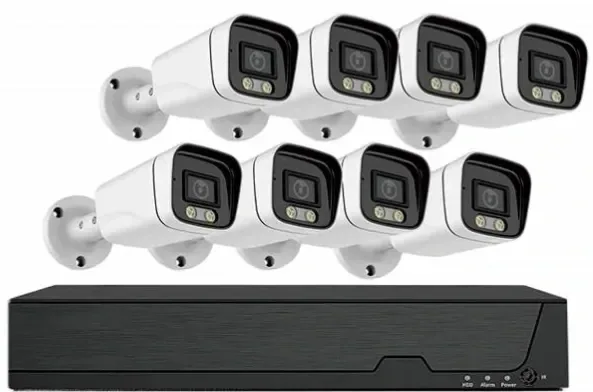
Run the widths from a typical drawing through the same arithmetic. Every fixed camera in our range — the FC5B bullet and the FC5D dome — is 5 MP at 2880 × 1620, so the third column is what these positions actually produce.
| Position | View width at the subject | Pixels per metre | What the operator gets |
|---|---|---|---|
| Entrance door, aimed across the opening | 2 m | 1440 | Identification with a wide margin |
| Reception counter and desk | 4 m | 720 | Identification, plus documents on the desk |
| Lift lobby | 6 m | 480 | Identification of anyone at the doors |
| Warehouse aisle | 20 m | 144 | Recognition along the racking |
| Car park aisle | 30 m | 96 | Observation; vehicles and movement |
| Perimeter road | 60 m | 48 | Detection, direction of travel |
| Yard, single wide camera | 115 m | 25 | Detection at the limit — a figure, at best |
Our 5 MP bullet and dome cameras are built for the first three rows: at a counter or a lobby the density is far past what a review needs, which is why the design effort belongs in the last three. A wide yard camera is a detection device whatever its resolution, and the honest way to cover a yard is a chain of positions with narrower views rather than one expensive camera in the corner.
Why does mounting height make it worse?
Because the camera measures its distance along the line of sight, and height adds to that line. A camera 3 m up looking at a subject 15 m away measures 15.3 m — a 2 per cent loss nobody notices. The same camera 5 m up looking at a subject 8 m away measures 9.4 m, an 18 per cent loss, and the view width is fixed while the distance grows: density falls with it.
Height then costs a second time, in angle. A face seen from 30 degrees above is foreshortened into the top of a head, and eye spacing — the detail identification actually runs on — is compressed by the same amount. Front-door and till cameras are happiest between about 2.5 m and 3.5 m: high enough that nobody reaches them from the ground, flat enough that a face stays a face. Above 4 m there has to be a reason — vandalism, a forklift, a loading bay — and the answer is then a narrower angle of view from further back, not a steeper look down.
When does a PTZ replace three fixed cameras?
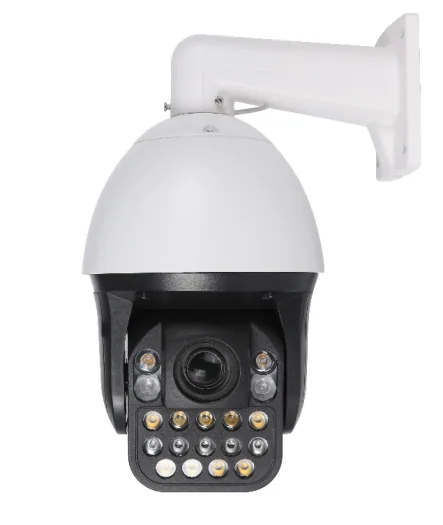
Zoom is the only honest way to hold a narrow view from a long way off, and it can be calculated the same way. To keep an 11.5 m identification width at 20 m the lens needs about 32 degrees horizontally; at 50 m, 13 degrees; at 150 m, 4.4 degrees. Our FC5P PTZ speed dome carries a 36× optical zoom on a 4.6–167 mm lens, so those angles are reachable, and it lists 150 m of infrared — that figure is the reach of the illuminator, not an identification distance, and the two are routinely confused in quotations.
What a PTZ does not do is watch everything at once. It is one view at a time: a preset tour revisits a scene every few minutes, and the event that matters usually happens between visits. Use it where an operator is watching, or where a scene needs to be inspected on demand, and keep fixed cameras on the doors and counters that must never be missed. The practical mix on most sites is fixed cameras for evidence and one PTZ for the wide view and the far gate.
What does detail cost in storage and bandwidth?
The sensor does not charge for pixels; the recorder does. Our cameras run the main stream at 500–8000 kbps and the sub-stream at 50–2000 kbps, so the same 5 MP camera can cost 21 GB a day or 84 GB a day depending on how the stream is set.
| Main-stream bitrate | Per camera, per day | 30 days, one camera | 30 days, four cameras |
|---|---|---|---|
| 2 Mbps | 21 GB | 633 GB | 2.5 TB |
| 4 Mbps | 42 GB | 1.27 TB | 4.9 TB |
| 8 Mbps | 84 GB | 2.53 TB | 9.9 TB |
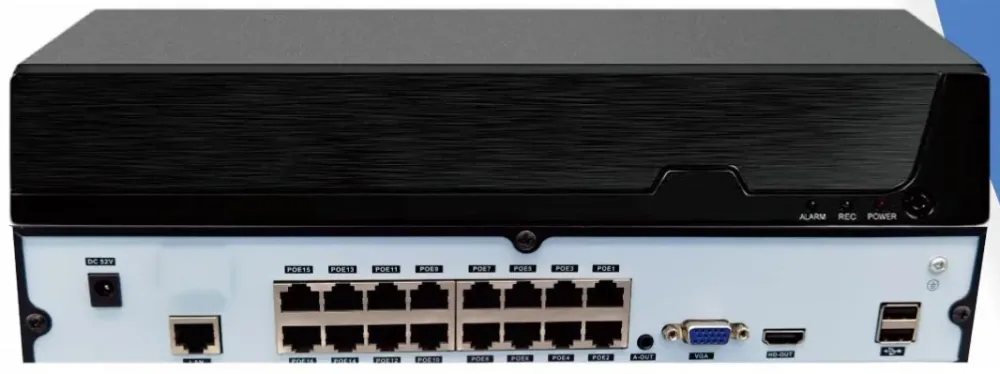
That table is the argument for putting density only where a review will happen. Recording every camera at 8 Mbps because the site might need it is how a 16-channel project turns into a 32-channel recorder and a disk order; the NVR range lists channel counts and drive bays so the storage can be sized from the arithmetic rather than from a habit. Live views on the monitor can come from the sub-stream, which leaves the main stream for the recording. Retention maths on its own is worked through in our storage guide.
What should be written on the drawing?
Five things per position, and the design survives its first site visit. Without them, the same argument is had again at handover, with a camera already in the wall.
- View width at the plane of the subject, in metres — measured on the plan, not estimated from the ceiling.
- Task level for that position: detect, observe, recognise or identify, and why that level and not the next one down.
- Pixels per metre that follows from the two numbers above, with the sensor width stated so the sum can be checked by anyone.
- Mounting height and tilt, so the person installing it is not free to choose a better view of the ceiling.
- What happens if the level is missed — a second position, a narrower lens, or an accepted downgrade written down as a decision.
The point of the arithmetic is not precision to the last pixel. It is that the site can be argued about on paper, at the price of a drawing, rather than in a review meeting six months later, at the price of an incident nobody can identify. If you send us a plan with view widths marked on it, our system planner returns a position list with densities, streams and storage already costed, and a quotation that follows from it rather than from a camera count.